Introduction
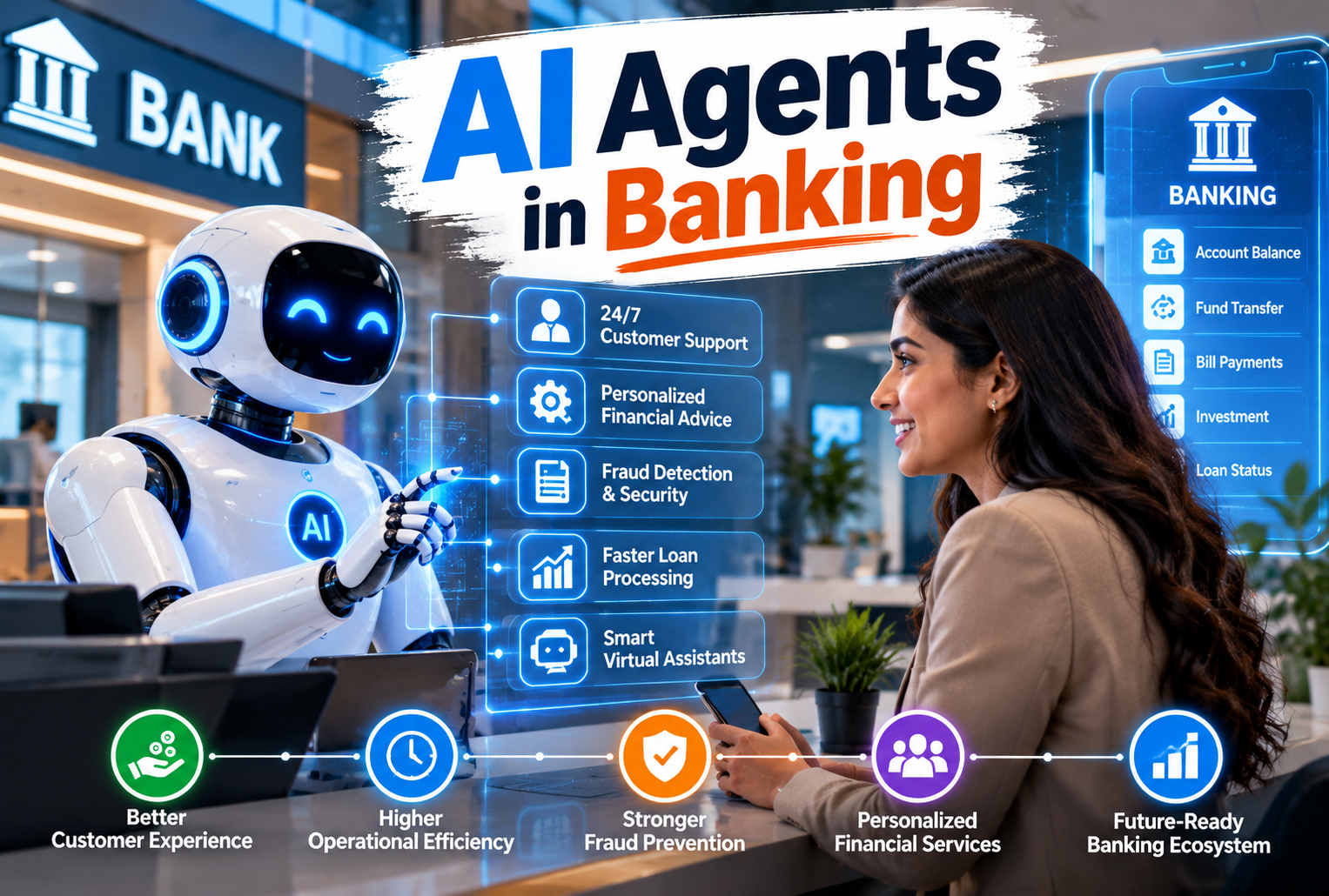
Artificial intelligence is becoming an important part of the financial services industry. Banks already use AI-related technology for activities such as customer support, fraud detection, document processing and risk analysis.
The next development is the growing interest in AI agents — systems designed to perform tasks, use digital tools and complete multi-step workflows with varying degrees of human supervision.
A recent Reuters report on AI adoption and risks in banking highlights the opportunities associated with AI investment alongside concerns about cybersecurity, financial exposure and the risks of autonomous systems.
What Are AI Agents?
Traditional software usually follows predefined instructions. AI agents can use AI models to interpret information, decide on possible next steps and interact with connected tools to complete a task.
Depending on their design and permissions, an agent might summarise documents, organise information, prepare reports or assist with internal business processes.
However, not every AI chatbot is an autonomous agent, and the capabilities of different systems vary. Many banking applications still require human review and approval before important decisions or transactions can proceed.
How Banks Could Use AI Agents
1. Improving Customer Support
AI-powered systems can help customers find information about banking services, understand routine procedures and navigate digital platforms.
More advanced agents may coordinate several steps in a support workflow, such as gathering relevant information and preparing a response for a human representative.
Sensitive account changes and financial transactions require appropriate identity verification, access controls and safeguards.
2. Supporting Fraud Detection
Banks process large volumes of transactions and need systems that can identify suspicious activity.
AI can help analyse patterns and flag unusual behaviour for further investigation. Agents may also assist analysts by collecting relevant information or preparing case summaries.
However, automated systems can produce false alarms or miss suspicious activity. Human oversight and established fraud-control procedures remain important.
3. Automating Internal Workflows
Financial institutions handle extensive documentation, compliance checks and administrative tasks. AI agents may help organise documents, extract information and prepare internal reports.
These uses could reduce repetitive work and help employees focus on complex cases.
The actual benefits depend on the quality of the underlying data, system reliability, integration costs and how effectively employees review the results.
4. Supporting Risk Analysis
AI tools can help analysts organise financial information, identify patterns and compare scenarios. Such capabilities may assist decision-making but should not automatically replace professional judgement.
Banks must consider data quality, model limitations and the consequences of incorrect outputs before relying on AI for important financial decisions.
What Are the Main Security Risks?
Unauthorised Access
An AI agent connected to sensitive systems may create risks if its permissions are too broad. A compromised account or poorly configured integration could expose confidential information.
Banks need least-privilege access, which means giving systems only the permissions necessary to perform their assigned tasks.
Incorrect or Misleading Outputs
AI systems can produce inaccurate summaries, recommendations or interpretations. If these outputs enter a financial workflow without proper checks, errors may affect customers or internal decisions.
Verification and human review are particularly important for high-impact actions.
Prompt Injection and Malicious Instructions
AI agents that process external documents, emails or websites may encounter malicious instructions designed to influence their behaviour.
Security measures should separate trusted instructions from untrusted content and prevent agents from taking unauthorised actions.
The OWASP Top 10 for Large Language Model Applications discusses security risks relevant to AI-powered applications.
Accountability and Compliance
Banks operate under regulatory requirements relating to customer information, financial transactions and risk management. Using AI does not remove an institution's responsibility to follow those requirements.
Financial institutions need clear policies explaining which tasks AI can perform, which decisions require human approval and how actions are recorded and reviewed.
How Can Banks Use AI More Safely?
A responsible AI strategy should combine technological controls with human oversight.
-
Limit permissions: Give each agent access only to the systems and data it needs.
-
Require approval for sensitive actions: Use human confirmation for high-risk transactions and important account changes.
-
Monitor activity: Maintain records of agent actions and investigate unusual behaviour.
-
Test before deployment: Evaluate accuracy, reliability and security in controlled environments.
-
Protect customer data: Apply suitable privacy controls, encryption and access policies.
-
Prepare incident procedures: Establish a process for disabling an agent and responding to security incidents.
The National Institute of Standards and Technology's AI Risk Management Framework provides guidance for identifying and managing AI-related risks.
What Does the Future Hold for AI in Banking?
AI agents could make some banking processes faster and help employees manage repetitive tasks. They may also support more personalised customer services and improve how institutions organise large amounts of information.
However, adoption will depend on whether banks can demonstrate reliability, manage security risks and meet applicable regulatory expectations.
The most effective approach is likely to combine automation with clear boundaries, monitoring and human responsibility rather than allowing unrestricted autonomous decision-making.
Conclusion
AI agents represent a potential next step in banking automation. They may support customer service, fraud analysis, documentation and internal workflows, but their capabilities also introduce new security and governance challenges.
The future of AI in banking will depend not only on what these systems can do, but also on how safely and responsibly institutions use them. Strong access controls, human oversight and continuous testing will remain essential as financial services adopt more advanced AI tools.