


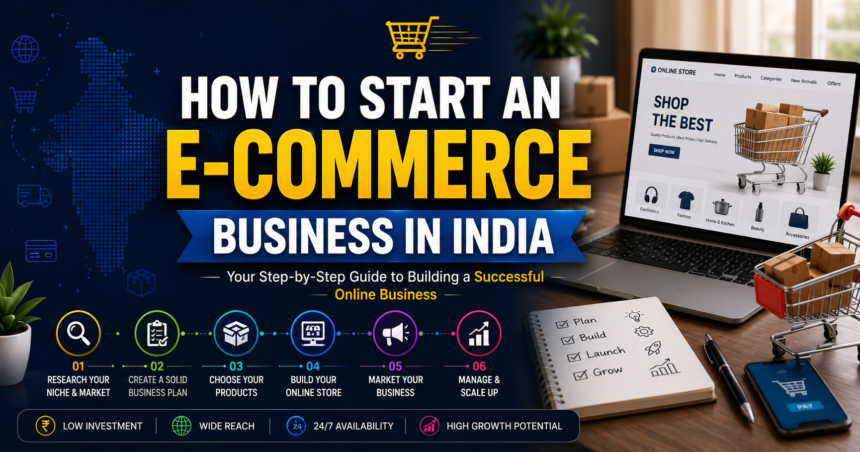
Starting an e-commerce business in India involves picking a niche, registering your business, building a website, integrating payments, and running marketing campaigns. With India’s e-commerce market projected to reach $350 billion by 2030, now is a strong time to launch an online store — even with zero prior experience.
India’s e-commerce market is growing at a pace that very few industries can match. Over 900 million internet users, a rapidly expanding middle class, and the widespread adoption of UPI payments have created an environment where online businesses can scale quickly. Platforms like Meesho, Nykaa, and Mamaearth started small and grew into billion-dollar businesses within a few years.
But here’s the thing — most people who want to start an online business in India don’t know where to begin. The paperwork feels overwhelming. The tech setup seems complicated. And the marketing side? That’s a whole other challenge.
This guide breaks everything down into simple, clear steps. By the end, you’ll know exactly how to start an e-commerce business in India — from picking a product to making your first sale. No complicated jargon. No fluff. Just practical steps you can actually follow.
What is an E-commerce Business?
An e-commerce business (online store) is any business that sells products or services over the internet. Customers browse your website or app, place orders, and you deliver the product to them.
E-commerce in India works across several models:
- B2C (Business to Consumer): You sell directly to customers (e.g., selling clothes online)
- B2B (Business to Business): You sell to other businesses (e.g., wholesale supplier)
- D2C (Direct to Consumer): You manufacture and sell your own products without a middleman
- Dropshipping: You sell products without holding inventory — the supplier ships directly to your customer
For most beginners in India, B2C or dropshipping is the easiest starting point.
Step 1: Choose Your Niche and Products
The first decision — and one of the most important ones — is deciding what to sell.
How to choose the right niche for your online store in India?
Pick a niche that meets these three criteria:
- Demand: People are actively searching for it online
- Profit margin: There’s enough room to make money after costs
- Low competition (or you have a unique angle): You can stand out from existing sellers
Popular e-commerce niches in India (2026):
- Fashion and ethnic wear
- Organic skincare and beauty products
- Home décor and furnishings
- Baby products
- Electronics accessories
- Health supplements and fitness gear
- Handmade and artisan crafts
How to validate your niche:
- Use Google Trends to check if demand is growing
- Search for your product on Amazon India and Flipkart — check reviews and sales
- Look at what’s trending on Meesho and Nykaa
Once you’ve identified a niche, shortlist 10–20 products to start with. Don’t try to sell 500 things at once.
Step 2: Write a Simple Business Plan
Before spending a single rupee, write down your business plan. It doesn’t need to be a 50-page document. A simple one-page plan works.
Your plan should cover:
- What you’re selling (products/niche)
- Who your target customers are (age, location, interests)
- How you’ll source products (manufacturer, wholesaler, dropshipping)
- Your pricing strategy (cost + profit margin)
- Your marketing channels (Instagram, Google Ads, etc.)
- Startup budget (how much money you’re starting with)
A business plan helps you stay focused and avoid wasting money on things that don’t matter early on.
Step 3: Register Your Business
To sell online legally in India, you need to register your business. Here’s what you need:
What business structure should you choose for an e-commerce business in India?
For most first-time e-commerce sellers, a Sole Proprietorship or Private Limited Company works best.
| Business Type | Best For | Cost |
|---|---|---|
| Sole Proprietorship | Beginners, low investment | Very low |
| Partnership Firm | 2–3 partners | Low |
| LLP (Limited Liability Partnership) | Small to medium businesses | Moderate |
| Private Limited Company | Scaling businesses | Higher |
Documents and registrations you’ll need:
- GST Registration: Mandatory if your turnover exceeds ₹20 lakhs (₹10 lakhs for special category states). Also required to sell on marketplaces like Amazon and Flipkart.
- PAN Card: For all financial transactions
- Bank Account (Current Account): For business payments
- Trademark Registration (optional but recommended): To protect your brand name
- MSME/Udyam Registration: Optional, but gives access to government schemes and benefits
How to register for GST:
- Visit the GST portal: gst.gov.in
- Click on “New Registration”
- Fill in your PAN, mobile number, and email
- Upload documents (Aadhaar, PAN, bank details, business address proof)
- Complete OTP verification
- Receive your GSTIN (GST Identification Number) within 3–7 working days
Step 4: Source Your Products
Once your business is registered, you need to figure out where your products will come from.
What are the best ways to source products for an online store in India?
Option 1 – Manufacturer/Wholesaler
Buy products in bulk at a low price and sell them at a higher price. Best for physical products with higher margins.
Popular sourcing platforms in India:
- IndiaMart (indiamart.com)
- TradeIndia (tradeindia.com)
- Alibaba (for international sourcing)
Option 2 – Dropshipping
No inventory needed. You list products on your website, and when someone orders, the supplier ships directly to them. Lower risk, but also lower margins.
Popular dropshipping platforms for India:
- GlowRoad
- Meesho (for resellers)
- Baapstore
Option 3 – Make Your Own Products
If you’re selling handmade items, art, or D2C products, you manufacture yourself. Higher effort, but highest brand control.
Always order samples before committing to bulk inventory. Check quality, packaging, and delivery speed yourself.
Step 5: Build Your E-commerce Website
Your website is your online shop. It needs to look professional, load fast, and make it easy for customers to buy.
How to build an e-commerce website in India without coding?
You have two main options:
Option A – Use a Ready-Made Platform (Recommended for Beginners)
| Platform | Best For | Monthly Cost |
|---|---|---|
| Shopify | All-in-one, easiest to use | ₹1,994–₹7,447 |
| WooCommerce | WordPress users, more control | Free (+ hosting) |
| Instamojo | Indian market, simple setup | Free to start |
| Dukaan | Hindi-friendly, very simple | ₹499–₹999/month |
| Wix eCommerce | Small stores, design-focused | ₹800–₹2,500/month |
Option B – Custom Development
Hire a developer to build a custom website. More expensive (₹20,000–₹2,00,000+), but fully customizable. Better for large, scaling businesses.
Key pages your website must have:
- Homepage with clear call-to-action
- Product pages with high-quality photos and descriptions
- About Us page (builds trust)
- Contact page
- Shipping and Return Policy page
- Privacy Policy and Terms of Service
Your domain name should be short, easy to spell, and reflect your brand. Register it on GoDaddy, Namecheap, or through your hosting provider.
Step 6: Set Up Payment Gateways
Customers need to pay you easily and securely. Setting up the right payment gateway is critical.
Which payment gateways work best for e-commerce in India?
Here are the most popular options:
| Payment Gateway | Transaction Fee | Best For |
|---|---|---|
| Razorpay | 2% per transaction | Most Indian businesses |
| PayU | 1.99–2.5% | Mid to large stores |
| Cashfree | 1.75–2% | Startups and SMEs |
| Instamojo | 2% + ₹3 | Small businesses |
| CCAvenue | Varies | Enterprise level |
What payment methods should your store support?
- UPI (PhonePe, Google Pay, Paytm)
- Credit and Debit Cards
- Net Banking
- EMI options
- Cash on Delivery (COD) — still very popular in India
Cash on Delivery (COD) tip: COD is the most preferred payment method in Tier 2 and Tier 3 cities in India. If you don’t offer it, you may lose a large portion of potential customers.
To set up a payment gateway, you’ll need:
- GST Number
- PAN Card
- Current bank account
- Business registration proof
Most platforms like Shopify and WooCommerce have direct integrations with Razorpay and PayU — setup takes less than an hour.
Step 7: Plan Your Logistics and Delivery
A great product with poor delivery will ruin your reputation fast. Sort your logistics setup early.
How to manage shipping for an e-commerce business in India?
Option 1 – Marketplace Fulfillment
If you sell on Amazon India (FBA) or Flipkart (Flipkart Fulfillment), they handle storage, packing, and delivery for you. Convenient but costly.
Option 2 – Third-Party Logistics (3PL)
Partner with a courier service for your own website orders. Popular options:
- Shiprocket — aggregates 17+ courier partners, best for small-medium stores
- Delhivery — one of India’s largest logistics companies
- BlueDart — premium delivery, faster speeds
- Ecom Express — strong Tier 2 and Tier 3 coverage
Key shipping considerations:
- Offer free shipping above a minimum order value (e.g., free shipping on orders above ₹499)
- Clearly state delivery timelines on your product page
- Have a clear return and refund policy — it builds customer trust
- Track return rates — high returns often signal product or sizing issues
Step 8: Market Your Online Store
Building a website is only half the job. You need to drive traffic to your store and turn visitors into buyers.
What are the most effective marketing strategies for e-commerce in India?
1. Social Media Marketing
Instagram and Facebook are the most powerful platforms for e-commerce in India. Post product photos, reels, customer testimonials, and behind-the-scenes content regularly.
- Use Instagram Reels for organic reach
- Run Facebook and Instagram ads to target specific customer groups by age, location, and interest
- Partner with micro-influencers (10K–100K followers) for affordable product promotions
2. WhatsApp Marketing
Over 500 million Indians use WhatsApp. Build a customer list and send product updates, offers, and order confirmations via WhatsApp Business. It has one of the highest open rates of any marketing channel.
3. Search Engine Optimization (SEO)
Optimize your website so it ranks on Google when people search for your products. Focus on:
- Product page titles and descriptions with relevant keywords
- Blog content that answers buyer questions
- Fast website speed (Google penalizes slow sites)
4. Google Ads
Run Google Shopping Ads or search ads targeting keywords like “buy [product] online India.” These are highly effective for driving purchase-ready traffic.
5. Marketplaces (Amazon and Flipkart)
List your products on Amazon India and Flipkart alongside your own website. Marketplaces bring ready-made traffic. Use them to build initial sales and reviews.
6. Email Marketing
Collect customer email addresses and send:
- Welcome offers for new subscribers
- Cart abandonment reminders
- New product announcements
- Festival sale campaigns (Diwali, Holi, etc.)
Tools like Mailchimp or Klaviyo integrate directly with Shopify and WooCommerce.
Common Mistakes to Avoid When Starting an E-commerce Business in India
Before you launch, be aware of the mistakes that trip up most new sellers:
- Skipping GST registration: Without it, you can’t sell on most marketplaces
- Poor product photos: Blurry or dark photos kill conversions — invest in good photography
- No return policy: Customers won’t buy from a store that doesn’t clearly explain returns
- Ignoring mobile users: Over 75% of Indian e-commerce traffic comes from mobile devices — your site must be mobile-friendly
- Spending too much on ads too early: Build organic traffic first, then scale with paid ads
- Not tracking numbers: Monitor your website analytics, ad spend, conversion rate, and return rate from day one
How Much Does It Cost to Start an E-commerce Business in India?
Here’s a rough cost breakdown for a beginner starting their own online store:
| Expense | Estimated Cost |
|---|---|
| Domain name | ₹500–₹1,500/year |
| Website hosting/platform | ₹500–₹2,000/month |
| GST registration | Free (government portal) |
| Initial inventory | ₹10,000–₹50,000 |
| Product photography | ₹2,000–₹10,000 |
| Logo and branding | ₹500–₹5,000 |
| Payment gateway setup | Free (% per transaction) |
| Marketing (social media + ads) | ₹5,000–₹20,000/month |
| Total Estimate | ₹20,000–₹90,000 |
You can start lean and scale as orders come in. Many successful Indian e-commerce businesses started with less than ₹25,000.
Start Your E-commerce Business in India Today
Starting an e-commerce business in India is genuinely achievable — even for someone with no prior business experience. The steps are straightforward: pick a product, register your business, build your website, set up payments, sort your logistics, and start marketing.
The hardest part isn’t the process. It’s taking the first step.
Start with one product. Set up a simple store. Make your first sale. Then improve from there. Every big e-commerce brand in India — from Mamaearth to Nykaa — started with someone deciding to sell something online.
Your turn.
Frequently Asked Questions
Can I start an e-commerce business in India without GST registration?
You can technically sell on your own website without GST if your turnover is below ₹20 lakhs per year. However, to sell on platforms like Amazon India, Flipkart, or Meesho, GST registration is mandatory regardless of turnover.
What is the minimum investment required to start an online store in India?
You can start an e-commerce business in India with as little as ₹15,000–₹25,000, especially if you use dropshipping (no inventory costs). A store with your own inventory typically requires ₹50,000–₹1,00,000 to start properly.
Which is better for beginners — selling on Amazon India or building your own website?
Starting on Amazon India or Flipkart gives you access to immediate traffic without needing to build an audience. Building your own website gives you more control and higher margins. The best approach is to do both — use marketplaces for early sales and build your own store for long-term brand growth.
What documents do I need to register an e-commerce business in India?
You need a PAN card, Aadhaar card, a current bank account, and your business address proof. For GST registration, you’ll also need a mobile number linked to Aadhaar and a valid email address.
How long does it take to start getting sales from an e-commerce store in India?
With marketplace listings (Amazon, Flipkart), you can start seeing sales within days. With your own website, expect 2–6 months of consistent marketing before generating reliable daily sales — unless you invest in paid advertising from the start.
Is dropshipping legal in India?
Yes, dropshipping is completely legal in India. You’ll still need a GST number if your turnover crosses the threshold, and you’re responsible for the customer experience even if a supplier fulfills the order.
Can I run an e-commerce business from home in India?
Yes. Many Indian e-commerce businesses operate fully from home. You can use your home address for GST registration and business documents. As your business grows, you may eventually need a warehouse or fulfillment center.