

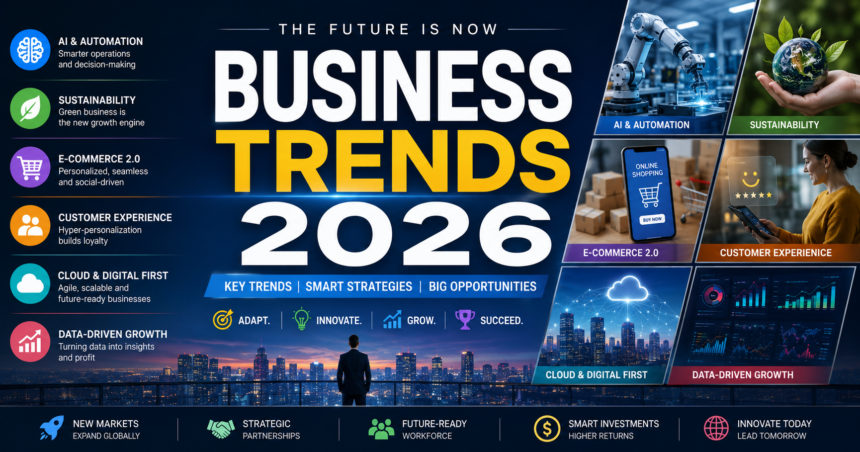
The business landscape of 2026 looks nothing like it did five years ago — and the gap between entrepreneurs who adapt and those who don’t is widening fast. From AI tools landing on Main Street to eCommerce surging past traditional retail, the business trends shaping 2026 are creating real opportunities for founders who pay attention. This guide breaks down the top business trends every entrepreneur needs to understand right now, backed by data from real small business surveys and expert research, so you can make smarter decisions about where to focus your energy this year.
Key Takeaways
- AI is no longer just for tech giants. According to a 2026 Guidant Financial survey of 845 small business owners, 18.7% plan to invest in AI tools this year — a first-ever tracked data point, signaling AI’s arrival on Main Street.
- Digital marketing is the #1 growth investment. 38.6% of small business owners are increasing digital marketing spend in 2026 — up nearly 4 points from 2025.
- Survival confidence is at a record high. 80.8% of small business owners expect their business to survive current economic pressures, up from 77.4% in 2025 (according to Guidant Financial, 2026).
- eCommerce and Retail lead industry growth. Retail (including eCommerce) surged to the #1 business sector in 2026, reaching 14.4% of new business activity.
- Sustainability is now a strategic imperative. According to London Business School faculty (December 2025), businesses that align climate initiatives with economic growth will hold a clear competitive advantage in 2026.
How Is AI Changing Business Operations in 2026?
AI is transforming how businesses operate at every level — from customer service to supply chain management. The clearest proof? For the first time ever, Guidant Financial’s 2026 Small Business Trends Survey captured AI investment as a tracked metric: 18.7% of small business owners now plan to invest in AI resources this year. Two years ago, that number wasn’t even being measured.
According to London Business School Professor Nicos Savva (Academic Director, Data Science and AI Initiative), the competitive advantage in 2026 won’t go to whoever has the smartest AI model. It will go to whoever has the richest, most context-specific data powering that model. Savva describes a rising discipline called “context engineering” — the deliberate design of information environments that allow AI to perform reliably within a specific business setting.
For entrepreneurs, this means:
- AI-powered marketing automation is becoming accessible at every budget level
- Scheduling, inventory management, and customer support are increasingly handled by AI tools
- “AI-native advertising” is emerging as a distinct marketing channel — one that delivers more personalized, targeted messaging than traditional digital ads
The businesses adopting AI tools early will compound efficiency gains quickly. Those who wait will spend the next few years catching up.
What Does Digital Transformation Look Like for Small Businesses in 2026?
Digital transformation in 2026 is less about sweeping overhauls and more about strategic, incremental upgrades. The Guidant Financial survey found that 38.6% of small business owners plan to increase digital marketing investment this year — the sharpest growth area in the entire survey.
This shift reflects what’s happening across the broader digital ecosystem. According to LBS Professor of Marketing Anja Lambrecht (December 2025), large language models (LLMs) are evolving from optional tools into built-in interfaces within browsers, search engines, and productivity software. This fundamentally changes how customers find businesses online.
Key digital transformation priorities for entrepreneurs in 2026:
- Shifting ad spend toward AI-native channels, where personalized messaging performs better
- Building owned content platforms that attract direct traffic, rather than relying solely on social algorithms
- Investing in digital marketing skills or outsourcing to specialists who understand the changing landscape
The businesses that treat digital marketing as an afterthought will find themselves competing for scraps. The ones investing now are building sustainable customer acquisition systems.
Why Is Sustainable Business Practice a Strategic Priority in 2026?
Sustainability is no longer a values statement — it’s a business strategy. According to LBS Associate Professor Ioannis Ioannou (Strategy and Entrepreneurship, December 2025), businesses that align sustainability directly with industrial productivity and energy resilience will be the ones rewarded by government policy and investor attention in 2026.
This matters for entrepreneurs for three practical reasons:
- Regulatory alignment: Environmental standards are tightening across the US, UK, and EU. Businesses that get ahead of compliance now avoid costly scrambles later.
- Investor scrutiny: ESG frameworks are spreading fast, including to regions like the Middle East where sovereign wealth funds are directing capital toward hydrogen, clean manufacturing, and circular-economy infrastructure.
- Consumer preference: Customers increasingly choose brands that demonstrate genuine environmental responsibility.
Sustainable business doesn’t require massive capital investment. Start with supplier choices, packaging decisions, and transparent reporting — then build from there.
Which Online Business Sectors Are Growing Fastest in 2026?
Retail — including eCommerce — is the fastest-growing business sector in 2026, jumping to the #1 spot at 14.4% of new business activity, up from 12.4% in 2025 (Guidant Financial, 2026). The blending of physical storefronts with online selling has dramatically lowered barriers to entry, making retail entrepreneurship accessible to a wider range of founders.
Other high-growth sectors include:
- Health, Beauty & Fitness (7.7%) — driven by durable consumer demand for wellness products and services
- Business Services (6.9%) — service-based businesses are scaling without requiring heavy physical infrastructure
- Residential & Commercial Services (7.9%) — strong across both urban and suburban markets
For online entrepreneurs, the opportunity is clear. Lower startup costs, global reach, and the ability to serve customers 24/7 make eCommerce one of the most accessible paths to building a business in 2026.
What Are the Biggest Small Business Trends in 2026?
Small business owners are demonstrating remarkable resilience this year, despite real economic pressures. Here’s what the data shows:
Small Business Optimism Is Rising
- 80.8% of small business owners expect to survive current economic hurdles — up from 77.4% in 2025 and the highest reading in recent survey history (Guidant Financial, 2026)
- 74.6% report feeling somewhat or very happy as business owners — a stable figure that has held steady despite political and economic turbulence
- The business happiness score held at 3.97 out of 5 for the second consecutive year
The Challenges Aren’t Gone
Cash flow and capital access now tie inflation as the top operational challenge, cited by 40.8% of owners. Inflation pressure (41.3%) has eased slightly from 48% in 2025, but its downstream effects on business liquidity remain significant.
How Small Businesses Are Responding
| Growth Investment | % of Owners Planning This |
|---|---|
| Increase staff | 44.6% |
| Digital marketing | 38.6% |
| Expand or remodel | 32.4% |
| Invest in AI resources | 18.7% |
The takeaway: small businesses are choosing offense over defense in 2026. Investment is accelerating, not retreating.
What Startup Trends Are Shaping 2026?
Starting a business in 2026 costs more than it ever has. The share of founders launching with over $500,000 in startup capital jumped to 31.6%, up from 27.5% in 2025 — a clear signal that rising costs in food service, retail, and franchising are escalating the price of entry (Guidant Financial, 2026).
Despite the higher bar, the motivation to start hasn’t dimmed. 56.9% of new business owners in 2026 chose entrepreneurship to be their own boss, while 48.8% cited dissatisfaction with corporate employment. A growing share — 18.2% — cited legacy-building as a core motivation, signaling a longer-term orientation among new founders.
The most popular startup models in 2026:
- New franchise locations (33.9%) — using brand recognition to reduce early-stage risk
- Existing independent businesses (30.4%) — bringing fresh perspectives to established operations
- New independent businesses from scratch (25.5%)
Generational leadership is also shifting. Gen X remains the dominant ownership cohort (~44%), followed by Baby Boomers (~32%), Millennials (~22%), and a small but growing slice of Gen Z (~2%).
What Business Innovations Will Drive Competitive Advantage in 2026?
The most impactful business innovations in 2026 aren’t necessarily new technologies — they’re new applications of existing ones.
Context Engineering and AI Personalization
As noted by LBS Professor Nicos Savva, the emerging discipline of context engineering allows businesses to build AI systems that are genuinely useful within their specific operating environment. A new category of “context-as-a-service” providers is emerging to help businesses curate, govern, and audit the information environments that create defensible competitive intelligence.
Human Judgment as a Competitive Asset
LBS Professor Andrew Likierman makes a compelling case that while AI can perform certain judgment-related tasks better than humans, the ability to exercise genuine judgment — to weigh ambiguous situations and make nuanced calls — remains uniquely human. Entrepreneurs who invest in sharpening their own judgment alongside their AI tools will hold a distinct advantage.
New Revenue Models
- 9.3% of small businesses introduced new revenue streams in 2026, responding to economic pressure with creativity rather than contraction
- Service-based business models that scale without physical infrastructure are gaining ground
- Subscription-based and recurring revenue models continue to outperform one-time transaction businesses
What Entrepreneur Success Tips Work Best in 2026?
Success in 2026 comes down to a handful of clear priorities:
1. Invest in digital marketing early. With 38.6% of your competitors doing the same, this isn’t optional. Build your online presence, understand your SEO fundamentals, and explore AI-native advertising channels.
2. Start using AI tools now, even simply. You don’t need to overhaul your operations overnight. Start with one area — customer service, content creation, or scheduling — and expand from there.
3. Outsource strategically. The most successful small business owners in 2026 know what to delegate. Tax preparation (outsourced by 80.8% of owners), payroll (63.3%), and bookkeeping (45.6%) top the list — and for good reason.
4. Manage cash flow aggressively. Cash flow overtook inflation as the #1 operational challenge this year. Keep a close eye on liquidity, even if revenue looks healthy.
5. Build for resilience, not just growth. The 80.8% survival confidence figure is encouraging — but it belongs to business owners who planned for volatility, not those who assumed smooth sailing.
What Business Trends Should Entrepreneurs Focus on to Stay Ahead in 2026?
2026 is a year that rewards the prepared. AI tools are no longer theoretical — they’re generating real efficiency gains for businesses that have adopted them. Digital marketing is delivering returns for the 38.6% of owners investing in it. And eCommerce continues to open global markets to founders who wouldn’t have had access even five years ago.
The data from Guidant Financial’s 2026 survey tells a consistent story: small business owners who are investing in people, technology, and digital channels are the ones reporting growth. Those waiting for the perfect moment are watching their more adaptable competitors pull ahead.
Audit where your business stands on each of the trends covered in this guide. Pick one area — AI, digital marketing, sustainability, or cash flow management — and commit to making meaningful progress in the next 90 days. That’s how business trends translate into real competitive advantage.
Frequently Asked Questions
What are the biggest business trends for entrepreneurs in 2026?
The top business trends in 2026 include AI adoption among small businesses (18.7% of owners plan to invest), digital marketing growth (38.6% increasing spend), eCommerce reaching its highest-ever share of new businesses at 14.4%, and sustainable business practices becoming strategically essential. These trends are backed by Guidant Financial’s 2026 Small Business Trends Survey and London Business School faculty research (December 2025).
Is AI really useful for small businesses in 2026, or just for large companies?
AI is genuinely useful for small businesses in 2026. The Guidant Financial survey recorded AI investment as a tracked small business metric for the first time in 2026, with 18.7% of owners planning to invest. Practical applications include AI-powered scheduling, customer service chatbots, marketing automation, and content generation — all available at price points accessible to small business budgets.
What industries are growing fastest for entrepreneurs in 2026?
Retail (including eCommerce) leads growth at 14.4% of new business activity, followed by Health, Beauty & Fitness (7.7%), Residential & Commercial Services (7.9%), and Business Services (6.9%), according to Guidant Financial’s 2026 survey.
How much does it cost to start a business in 2026?
Startup costs are rising. In 2026, 31.6% of new business owners launched with over $500,000 in capital — up from 27.5% in 2025. Costs vary significantly by industry, with food service, retail, and franchising requiring the highest upfront investment. Service-based businesses typically require significantly less capital.
What are the biggest challenges facing small businesses in 2026?
Cash flow and capital access are now tied with inflation as the top challenges, each cited by roughly 40% of small business owners in the Guidant Financial 2026 survey. Recruiting and retention fell 7 points to 31.5% as the labor market normalizes — a rare bright spot in an otherwise demanding environment.
Is sustainability important for small business success in 2026?
Yes. According to LBS Associate Professor Ioannis Ioannou (December 2025), businesses that align sustainability with economic productivity and energy resilience will be better positioned to attract investment and meet evolving regulatory requirements. Sustainability is increasingly a competitive differentiator, not just a values statement.
What does “digital transformation” mean for a small business in 2026?
For small businesses in 2026, digital transformation primarily means investing in digital marketing (38.6% of owners are doing so), leveraging AI tools for efficiency, and building an online presence that attracts customers directly. It doesn’t require a complete operational overhaul — strategic, incremental improvements deliver measurable results.