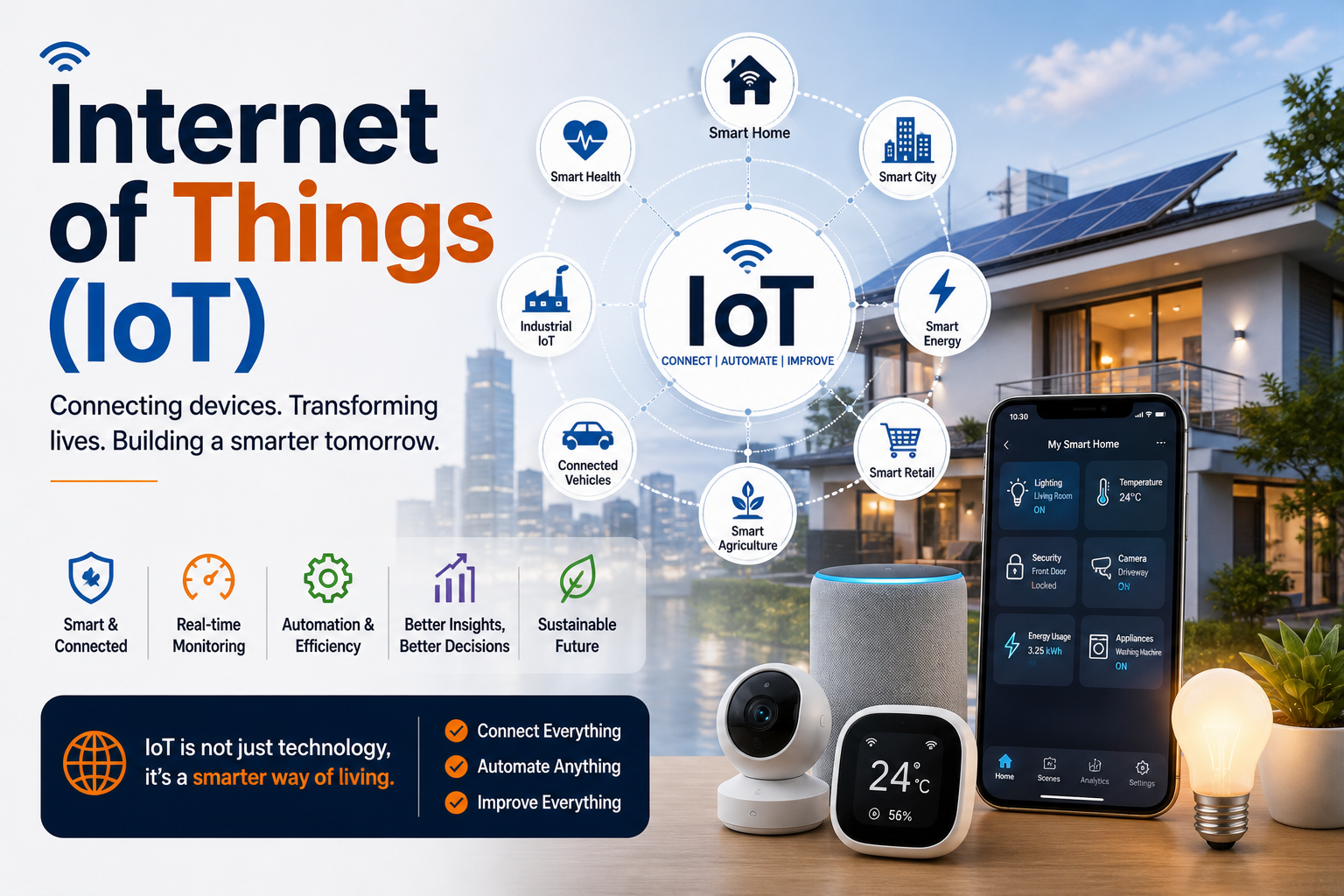
The Internet of Things (IoT) is changing how people live, work, and interact with technology. From smartwatches and smart home devices to connected cars and industrial machines, IoT technology is making everyday activities more convenient, efficient, and intelligent.
But what is the Internet of Things, and how does it work? In simple terms, IoT refers to a network of physical objects connected to the internet that collect, share, and exchange data. These connected devices can help people monitor activities, automate tasks, and make better decisions.
In this guide, you will learn how IoT works, explore real-world Internet of Things examples, understand its benefits and challenges, and discover how connected devices are shaping the future.
What Is the Internet of Things (IoT)?
The Internet of Things (IoT) is a system of physical devices connected to the internet that use sensors, software, and other technologies to collect and exchange data.
These devices can include household appliances, wearable gadgets, vehicles, security cameras, medical equipment, and industrial machines. They collect information from their surroundings and send it to other devices or software platforms for analysis.
For example, a smart thermostat can detect the temperature inside your home and automatically adjust the heating or cooling according to your settings. Similarly, a fitness tracker can measure your daily steps, heart rate, and physical activity.
The main purpose of IoT is to connect physical objects with digital technology so they can perform tasks more efficiently, sometimes with little or no human involvement.
Simple Examples of IoT
Here are some everyday examples of the Internet of Things:
-
Smartwatches: Track steps, heart rate, and physical activity.
-
Smart home devices: Control lights, fans, and thermostats remotely.
-
Connected cars: Share vehicle information and support navigation.
-
Smart security cameras: Allow users to monitor their homes remotely.
-
Industrial sensors: Help businesses monitor machine performance.
-
Smart agriculture systems: Measure soil moisture and support efficient irrigation.
These examples show how IoT applications can make daily life easier while helping businesses save time and resources.
How Does IoT Work?
Understanding how IoT works becomes easier when you look at the process step by step. Most IoT systems use connected devices, sensors, internet connectivity, data processing, and a user interface.
Here is how the process works.
1. Devices Collect Data
The first step involves collecting information from the surrounding environment. IoT devices use sensors to measure different conditions, such as temperature, movement, humidity, pressure, location, or light.
For example, a smart agriculture sensor can measure how much moisture is present in the soil.
2. Devices Send Data Through a Network
After collecting information, the device sends the data through a communication network. Depending on the system, this connection may use Wi-Fi, Bluetooth, cellular networks, Ethernet, or other communication technologies.
For instance, a smart security camera can send video or alerts to a connected smartphone or cloud service.
3. Data Is Processed
The collected data is processed to identify useful information or determine what action should happen next.
Processing can take place in the cloud, on a local computer, or directly on the device through edge computing.
For example, a smart thermostat can compare the current room temperature with the temperature selected by the user.
4. The System Takes Action
Once the data has been processed, the system can provide information, send an alert, or automatically perform an action.
A smart irrigation system might switch on a water pump when soil moisture drops below a selected level. A connected industrial machine might alert an operator when it detects unusual vibration.
5. Users Monitor and Control Devices
Many IoT systems provide a mobile application, website, or dashboard that allows users to monitor information and control connected devices.
Users can check device status, change settings, receive notifications, and review historical data.
In simple words: IoT devices collect data, send it through a network, process it, and use the results to provide information or perform useful actions.
What Are IoT Devices?
IoT devices are physical objects equipped with sensors, software, or network connectivity that allow them to collect and exchange data.
Some devices work independently, while others connect to a central hub, smartphone, computer, or cloud platform.
Common categories of IoT devices include:
Smart Home Devices
Smart bulbs, connected thermostats, smart plugs, door locks, and security cameras help people automate household tasks and manage their homes remotely.
Wearable Devices
Smartwatches and fitness trackers collect information about movement, exercise, and other measurements supported by the device.
Healthcare Devices
Connected medical equipment can help healthcare professionals monitor selected patient measurements and manage certain types of remote monitoring.
Industrial IoT Devices
Industrial sensors, connected machines, and monitoring systems collect information about equipment performance, operating conditions, and production processes.
Smart City Devices
Connected streetlights, traffic sensors, parking systems, and environmental monitors can help cities manage resources and public infrastructure.
Real-World Internet of Things Examples
IoT technology is used across many industries. The following Internet of Things examples demonstrate how connected devices can solve practical problems.
1. IoT in Smart Homes
Smart homes use connected devices to make household activities more convenient.
For example, users can control lighting through a mobile application, receive alerts when a security camera detects movement, or set a thermostat to maintain a preferred temperature.
Some devices can also work together through automation rules. For example, smart lights can switch off automatically when a room is unoccupied, if the system supports that function.
2. IoT in Healthcare
Healthcare organizations use connected technology to collect and monitor certain types of health-related data.
Wearable devices can record activity and selected health measurements, while compatible remote monitoring equipment can transmit patient readings to healthcare professionals.
These systems may help support remote care and provide additional information for clinical decisions. However, their accuracy and usefulness depend on the equipment, clinical context, and professional oversight.
3. IoT in Manufacturing
Manufacturing businesses use the Industrial Internet of Things (IIoT) to monitor machines, production lines, and equipment conditions.
Sensors can measure temperature, vibration, pressure, and other operating parameters. The collected data can help maintenance teams identify unusual conditions before they lead to equipment failure.
IoT-based monitoring can also help manufacturers improve production visibility, reduce unplanned downtime, and understand how machines are performing.
4. IoT in Agriculture
Smart agriculture uses connected sensors and automated systems to improve farming operations.
Soil sensors can measure moisture levels, weather stations can collect environmental information, and connected irrigation systems can help farmers manage water use.
These IoT applications can support more informed farming decisions and help reduce unnecessary resource consumption.
5. IoT in Transportation
Connected vehicles and transportation systems use sensors, GPS, and communication technologies to share useful information.
Fleet managers can monitor vehicle locations, review selected vehicle data, and plan routes more efficiently. Some connected vehicle systems can also provide maintenance alerts or information about driving conditions.
6. IoT in Retail
Retail businesses can use connected sensors to monitor inventory, track storage conditions, and improve operational visibility.
For example, temperature sensors can alert staff when refrigerated storage moves outside an acceptable temperature range. Connected inventory systems can also help businesses understand stock levels more accurately.
What Are the Main Components of IoT Technology?
An IoT system typically includes several important components that work together.
Sensors and Devices
Sensors collect information from the physical environment. Devices may also include actuators, which perform actions such as opening a valve, switching on a light, or adjusting a motor.
Connectivity
Connectivity allows devices to transmit data to other devices, gateways, or software platforms. Common technologies include Wi-Fi, Bluetooth, cellular networks, and Ethernet.
Data Processing
Processing software analyzes the collected information and determines whether an action, notification, or other response is required.
User Interface
A dashboard, mobile app, or web application allows people to view information, manage settings, and interact with the IoT system.
Security and Device Management
IoT systems also need security controls, device updates, access management, and monitoring to help protect connected devices and the information they handle.
Benefits of IoT
The benefits of IoT extend across homes, businesses, healthcare, agriculture, and manufacturing.
1. Automation and Convenience
Connected devices can perform repetitive tasks automatically. This reduces the need for people to control every activity manually.
2. Real-Time Monitoring
IoT systems can provide current information about equipment, environmental conditions, and device status. This helps users respond to changes more quickly.
3. Better Efficiency
Businesses can use connected sensors and data analysis to identify inefficient processes and improve how they use time, energy, and materials.
4. Predictive Maintenance
Industrial IoT systems can monitor equipment conditions and identify patterns associated with potential problems. This information can help maintenance teams plan inspections and repairs.
Predictive maintenance depends on suitable sensors, reliable data, and effective analysis; it does not guarantee that every equipment failure can be predicted.
5. Improved Decision-Making
IoT data can help individuals and organizations understand what is happening in their environment and make more informed decisions.
6. Resource Management
Smart irrigation, energy monitoring, and connected building systems can help users track resource consumption and identify opportunities to reduce waste.
Challenges and Disadvantages of IoT
Although IoT offers many advantages, it also creates challenges that users and businesses should consider.
1. Security Risks
Connected devices can become targets for cyberattacks, especially when they use weak passwords, outdated software, or insecure network connections.
Users should choose devices from trusted manufacturers, change default passwords, install updates, and secure their networks.
2. Privacy Concerns
Some IoT devices collect personal, location, behavioral, or environmental information. If this data is collected or shared without appropriate safeguards, it can create privacy risks.
Before using a connected device, review its privacy settings, data collection practices, and permissions.
3. Internet Dependency
Many IoT devices rely on network connectivity to provide remote access or cloud-based features. If the connection fails, some functions may become unavailable.
Certain devices can continue performing local functions without an internet connection, depending on their design.
4. Compatibility Issues
Different manufacturers may use different platforms and communication standards. As a result, some devices may not work together seamlessly.
Checking compatibility before purchasing connected equipment can help avoid this problem.
5. Setup and Maintenance Costs
IoT systems may require sensors, networking equipment, software subscriptions, installation, and ongoing maintenance. Businesses should evaluate these costs against the expected benefits.
What Is the Difference Between IoT and AI?
IoT and artificial intelligence (AI) are related technologies, but they serve different purposes.
The Internet of Things connects physical devices and allows them to collect, share, and transmit data. Artificial intelligence enables computer systems to analyze information, recognize patterns, generate predictions, or make decisions.
For example, an IoT sensor installed on a machine can collect vibration data. An AI system can analyze that data to identify patterns that may indicate a developing mechanical problem.
When combined, IoT and AI can support smarter automation, predictive maintenance, and data-driven decision-making.
However, IoT does not always require AI. Many connected devices operate using simple rules and predefined instructions.
What Is the Future of the Internet of Things?
The future of IoT is closely connected to developments in artificial intelligence, edge computing, faster connectivity, and improved cybersecurity.
Several trends are shaping the development of IoT technology.
Smarter Industrial Operations
Manufacturers are increasingly exploring connected equipment, real-time monitoring, and data-driven maintenance to improve production visibility and operational efficiency.
Growth of Smart Homes
Connected lighting, security systems, appliances, and energy management devices are making home automation more accessible.
Connected Healthcare
Remote monitoring devices and connected healthcare equipment can help support care delivery when used appropriately and integrated into suitable healthcare workflows.
Smart Cities and Infrastructure
Connected traffic sensors, energy systems, parking technology, and environmental monitoring can help cities understand infrastructure needs and manage selected public services.
Edge Computing and AI Integration
Edge computing allows some data processing to happen closer to the device rather than sending every piece of information to the cloud. Combined with AI, this can support faster responses and reduce unnecessary data transmission in suitable applications.
As the technology develops, security, privacy, interoperability, and responsible data management will remain important considerations.
Conclusion
The Internet of Things (IoT) connects physical devices to digital networks so they can collect data, communicate, and support useful actions. From smart home appliances and wearable devices to connected healthcare systems and industrial machines, IoT is becoming an important part of modern technology.
Understanding how IoT works helps individuals and businesses recognize its potential benefits, practical applications, and possible risks.
Although challenges such as security, privacy, connectivity, and compatibility remain, carefully designed IoT systems can improve monitoring, automation, and resource management.
As connected devices continue to evolve, IoT will play an important role in building smarter homes, more efficient businesses, and better-connected environments.