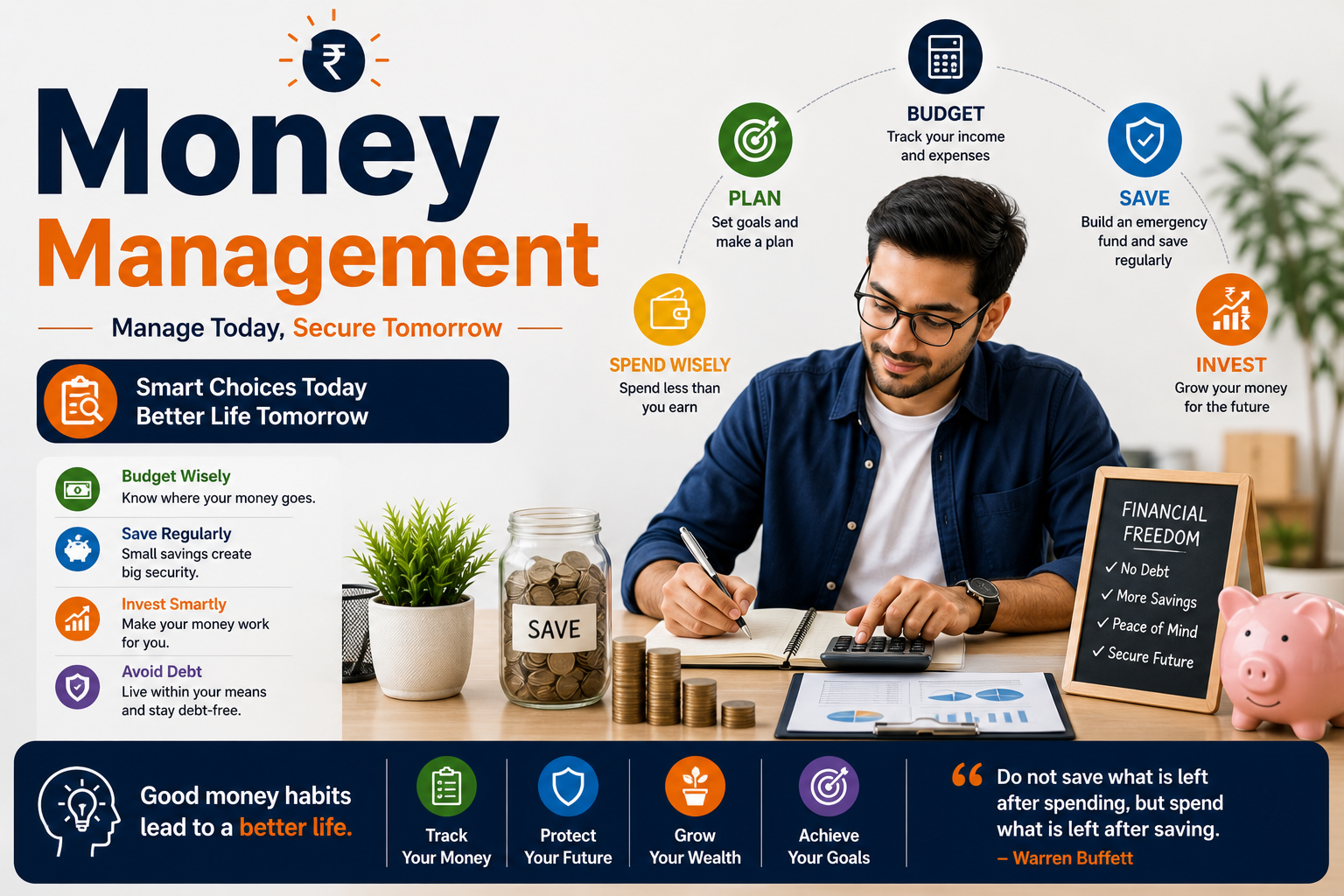
Managing money effectively is an important skill that can help you reduce financial stress, achieve your goals, and prepare for unexpected expenses. Whether you have just started earning, want to save more every month, or are trying to control your spending, learning money management can make a real difference.
Many people struggle with their finances because they do not have a clear budget, spend more than they earn, or save only when money is left at the end of the month. The good news is that you do not need a high income or advanced financial knowledge to build better financial habits.
With the right approach, you can understand where your money goes, manage your expenses, reduce debt, and build savings over time.
In this beginner's guide, you will learn how to manage your money effectively, create a monthly budget, save money consistently, manage debt, and develop smart money habits for a more secure financial future.
What Is Money Management?
Money management is the process of planning, tracking, saving, and using your money to meet your current needs and future financial goals.
It involves understanding your income, controlling expenses, building savings, managing debt, and making informed financial decisions.
Effective money management does not mean avoiding every purchase or living an uncomfortable life. It means spending intentionally, prioritizing what matters most, and making sure your money supports your goals.
For example, if you receive a monthly salary, you can divide your income between essential expenses, savings, debt payments, and personal spending. This approach helps you understand how much money you have available and prevents unnecessary overspending.
Good money management can help you:
-
Keep track of your income and expenses.
-
Save money for emergencies and future goals.
-
Avoid unnecessary debt.
-
Prepare for major expenses.
-
Make more confident financial decisions.
-
Work toward long-term financial security.
1. Understand Your Income and Expenses
The first step in money management is knowing how much money you earn and where it goes.
Many people know their monthly income but do not track smaller expenses such as food delivery, subscriptions, shopping, and entertainment. These costs may seem insignificant individually, but they can add up over time.
Start by calculating your total monthly income after taxes and other payroll deductions. Include other reliable sources of income when appropriate.
Next, list your monthly expenses.
Fixed Expenses
Fixed expenses are costs that generally remain similar from month to month.
Examples include:
-
Rent or home loan payments.
-
Insurance premiums.
-
School or education fees.
-
Internet and phone bills.
-
Regular loan payments.
Variable Expenses
Variable expenses change depending on your usage and lifestyle.
Examples include:
-
Groceries and dining out.
-
Electricity and water bills.
-
Fuel and transportation.
-
Clothing and shopping.
-
Entertainment and travel.
Occasional Expenses
Some expenses occur only a few times a year, such as vehicle maintenance, annual insurance payments, festivals, or medical bills.
Estimate these costs and set aside money for them each month instead of treating them as unexpected expenses.
Practical tip: Track your spending for at least 30 days. You can use a notebook, spreadsheet, or budgeting application. Reviewing your actual spending makes it easier to identify areas where you can save.
2. Create a Monthly Budget
Monthly budget planning helps you decide how to use your income before you spend it.
A budget is not a restriction. It is a plan that helps you balance your needs, wants, savings, and financial responsibilities.
One popular budgeting method is the 50/30/20 rule.
Understanding the 50/30/20 Budget Rule
The 50/30/20 rule divides your after-tax income into three broad categories:
-
50% for needs: Housing, groceries, essential transportation, utilities, and necessary bills.
-
30% for wants: Entertainment, dining out, hobbies, and non-essential shopping.
-
20% for savings and debt repayment: Emergency savings, future goals, and additional debt payments.
For example, if your monthly take-home income is ₹40,000, the suggested allocation would look like this:
| Category | Percentage | Monthly amount |
|---|---|---|
| Needs | 50% | ₹20,000 |
| Wants | 30% | ₹12,000 |
| Savings and debt goals | 20% | ₹8,000 |
| Total | 100% | ₹40,000 |
These percentages are a starting point, not strict rules. If you live in an expensive city, support family members, or have significant debt, you may need to adjust the amounts to suit your situation.
The most important part of budgeting is making a realistic plan that covers essential expenses while helping you save regularly.
3. Set Clear Financial Goals
Saving becomes easier when you know what you are saving for.
Instead of setting a general goal such as "I want to save more money," choose specific financial targets with a clear amount and timeline.
You can divide your goals into three categories.
Short-Term Financial Goals
These are goals you hope to achieve within the next year or so.
Examples include saving for a new phone, paying an annual insurance premium, or building your initial emergency savings.
Medium-Term Financial Goals
These may take a few years to achieve.
Examples include saving for a vehicle, preparing for education expenses, or building a deposit for a home.
Long-Term Financial Goals
These goals usually require planning over many years.
Examples include retirement planning, long-term wealth creation, or preparing for future family expenses.
Write down each goal, estimate its cost, and decide how much you need to save regularly.
For instance, if you want to save ₹24,000 in 12 months, you would need to set aside ₹2,000 per month, assuming no interest or investment returns.
Clear goals turn money management into a practical plan rather than a vague intention.
4. Build an Emergency Fund
An emergency fund is money set aside for unexpected expenses or a sudden loss of income.
Without emergency savings, an unexpected medical bill, urgent home repair, or period of unemployment may force you to borrow money or use savings intended for other goals.
A common starting target is to build an emergency fund covering three to six months of essential living expenses. The right amount depends on your job stability, family responsibilities, insurance coverage, and other financial circumstances.
How to Start an Emergency Fund
-
Calculate your essential monthly expenses.
-
Choose an initial savings target that feels achievable.
-
Transfer a fixed amount into savings regularly.
-
Keep emergency money accessible when needed.
-
Replenish the fund after using it for a genuine emergency.
For example, if your essential expenses are ₹20,000 per month, a three-month emergency fund would be ₹60,000, while a six-month fund would be ₹1,20,000.
You do not need to save the entire amount immediately. Start with a smaller target and build your fund gradually.
Emergency savings are generally best kept in an accessible, relatively low-risk place rather than in investments that may fluctuate significantly in value.
5. Learn How to Save Money Every Month
Learning how to save money is one of the most important parts of personal finance.
A useful strategy is to save a portion of your income as soon as you receive it rather than waiting until the end of the month.
This approach is sometimes called paying yourself first.
Practical Ways to Save Money
Automate your savings. Set up a regular transfer to a separate savings account after receiving your salary.
Review subscriptions. Cancel services you rarely use.
Plan grocery shopping. Prepare a list before visiting the store to reduce impulse purchases and food waste.
Compare prices. Check prices and total costs before making major purchases.
Limit impulse buying. Wait 24 hours before purchasing non-essential items. For expensive purchases, consider waiting longer.
Reduce avoidable fees. Review bank charges, late payment fees, and recurring service costs.
Set spending limits. Choose reasonable limits for dining out, shopping, and entertainment.
Small changes can improve your finances when you maintain them consistently. The goal is not to eliminate every enjoyable expense but to make sure your spending reflects your priorities.
6. Manage Debt Wisely
Debt management is an important part of financial planning. Loans and credit can sometimes help you meet important needs, but high-interest debt can make saving and reaching financial goals more difficult.
Start by listing all your debts, including credit cards, personal loans, vehicle loans, and other outstanding balances.
For each debt, note:
-
The remaining balance.
-
The interest rate.
-
The minimum monthly payment.
-
The due date.
-
Any applicable fees or early repayment conditions.
Always make required payments on time when possible, and prioritize understanding the cost of high-interest debt.
Two Common Debt Repayment Strategies
Debt avalanche method: Make the required payments on all debts, then direct extra repayment money toward the debt with the highest interest rate. Once that debt is cleared, move to the next-highest interest rate.
This method can reduce total interest costs when other terms are comparable.
Debt snowball method: Make the required payments on all debts, then direct extra money toward the smallest outstanding balance first. Once it is paid off, move to the next-smallest balance.
This method may help some people stay motivated by creating early progress.
Neither method replaces the need to keep up with minimum payments. If you are struggling to make payments, contact your lender early to discuss available options.
Avoid taking on additional high-interest debt to maintain a lifestyle you cannot comfortably afford.
7. Understand Saving and Investing
Saving and investing are related, but they serve different purposes.
Saving generally involves keeping money available for short-term needs and emergencies. Investing involves putting money into assets with the aim of achieving future growth, while accepting that returns are uncertain and losses are possible.
Before investing, consider your emergency fund, existing debt, financial goals, and how long you can leave the money invested.
Common Saving Options
Depending on your country and circumstances, saving options may include bank savings accounts, fixed deposits, and other suitable deposit products.
Review access restrictions, interest rates, applicable taxes, and deposit protection rules before choosing an option.
Common Investment Options
Investment options may include diversified mutual funds, shares, bonds, and retirement-oriented products, depending on local regulations and eligibility.
Each option has different levels of risk, liquidity, costs, and potential returns.
For beginners, it is important to understand what an investment owns, how its value can change, what fees apply, and whether it matches your time horizon.
Do not invest emergency money in volatile assets simply because they appear to offer higher returns. Avoid investments promising guaranteed high returns without credible supporting evidence.
Important: Investment choices should be based on your individual circumstances, not just on trends or recommendations from social media.
8. Use Technology to Improve Money Management
Digital tools can make budgeting and expense tracking easier.
You do not need an expensive financial application to manage your money. A simple spreadsheet or notebook may be enough to get started.
Useful tools and habits include:
-
Budgeting apps that categorize expenses.
-
Spreadsheet templates for monthly budgets.
-
Banking alerts for transactions and bill payments.
-
Calendar reminders for due dates.
-
Automatic transfers for recurring savings.
-
Monthly reviews of account statements.
When using financial applications, protect your personal information. Use strong passwords, enable multi-factor authentication where available, and download applications only from trusted sources.
Never share your banking PIN, password, or one-time verification code with someone claiming to help manage your finances.
Technology can help you understand your money, but regular review and sensible decisions remain essential.
9. Develop Smart Money Habits
Good financial health usually comes from consistent habits rather than one major change.
Developing a simple routine can help you stay organized and make progress toward your goals.
Review Your Finances Weekly
Spend a few minutes checking your account balances, recent transactions, and upcoming payments.
This helps you notice unusual spending and avoid missing important bills.
Review Your Budget Monthly
At the end of each month, compare your planned budget with your actual expenses.
If one category consistently exceeds its limit, adjust your plan or look for a realistic way to reduce spending.
Increase Savings When Income Grows
If you receive a salary increase, bonus, or additional income, consider directing a portion toward savings, debt repayment, or long-term goals before increasing discretionary spending.
Avoid Lifestyle Inflation
Lifestyle inflation happens when spending rises every time income increases.
You can enjoy some improvements in your lifestyle while still directing part of any additional income toward financial goals.
Protect Your Financial Information
Monitor your accounts, use secure payment methods, and be cautious of suspicious messages, unexpected payment requests, and investment scams.
These smart money habits can gradually improve your financial confidence and help you maintain a more stable budget.
10. Common Money Management Mistakes to Avoid
Even people with regular incomes can experience financial difficulties when they develop habits that work against their goals.
Here are some common mistakes to watch out for.
Not tracking expenses: Without knowing where money goes, it is difficult to identify unnecessary spending.
Saving only what remains: If you wait until the end of the month, there may be little left to save. Set aside a realistic amount early.
Ignoring high-interest debt: Interest charges can make balances harder to repay over time.
Having no emergency fund: Unexpected costs may force you to borrow money or interrupt progress toward other goals.
Making emotional purchases: Shopping to relieve stress or reacting to limited-time offers can lead to unnecessary expenses.
Investing without understanding the risks: Never put money into an investment simply because someone promises quick profits.
Following an unrealistic budget: A budget that ignores essential expenses or personal circumstances is difficult to maintain.
You can avoid many of these problems by reviewing your finances regularly, making realistic decisions, and adjusting your plan as your circumstances change.
A Simple 30-Day Money Management Plan
If you are new to budgeting, start with a practical 30-day plan instead of trying to change everything at once.
Week 1: Understand Your Money
Record your income, list your regular bills, and track daily spending. Identify where most of your money goes.
Week 2: Create Your Budget
Divide your income into essential expenses, discretionary spending, savings, and debt payments. Adjust the amounts to fit your actual circumstances.
Week 3: Start Saving and Review Debt
Set a realistic automatic savings amount and list your debts by balance and interest rate. Choose a repayment approach that fits your needs.
Week 4: Review and Improve
Compare your actual spending with your budget. Identify one or two changes you can maintain in the following month.
At the end of 30 days, you should have a clearer picture of your finances and a practical starting point for improving your money habits.
You do not need to achieve every financial goal in one month. Consistent progress is more important than perfection.
Conclusion
Learning how to manage your money effectively can help you take greater control of your finances and prepare for future needs.
Start by understanding your income and expenses, creating a realistic monthly budget, setting clear goals, and building an emergency fund. Then work on reducing expensive debt, saving regularly, and learning about investments before making financial commitments.
Remember that money management is a continuous process. Your budget and priorities may change as your income, responsibilities, and goals change.
You do not need to make huge sacrifices to get started. Small, consistent improvements can help you develop healthier financial habits and work toward greater financial security over time.
The best time to start managing your money is now. Choose one practical step today, follow it consistently, and build from there.