
Money abroad works differently from money at home. Between exchange rates, card fees, and helpful-sounding prompts at the checkout, it is surprisingly easy to lose a few percent on every purchase. None of these costs is large in isolation, but across a trip they add up.
The good news is that a handful of habits removes most of them.
The main places fees hide
Foreign transaction fees
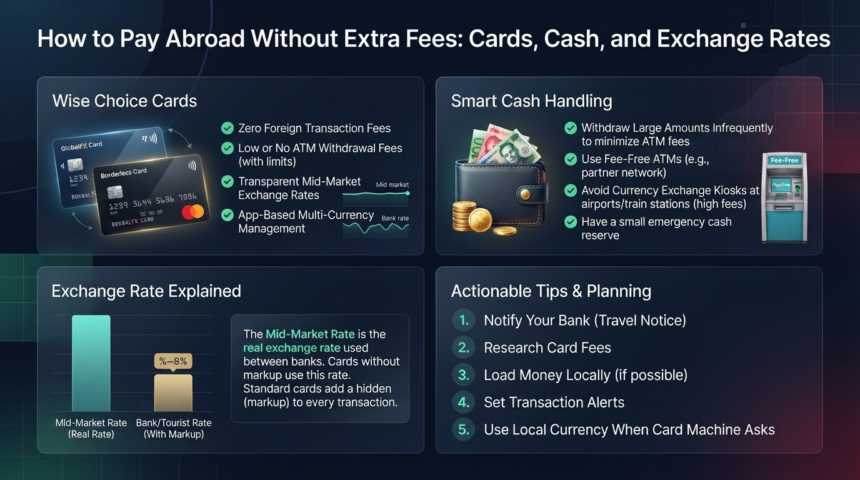
Many credit and debit cards add a fee, often a few percent, when you pay in another currency or through a foreign bank. Some cards charge none. Check your card terms before you leave and, if needed, use a card designed for travel.
Dynamic currency conversion
At a terminal or ATM abroad, you may be asked whether you want to pay in your home currency or the local one. The home-currency option is called dynamic currency conversion, and it usually applies a less favorable exchange rate. In most cases, choose the local currency.
ATM fees
Cash withdrawals can involve your bank’s fee, the ATM operator’s fee, and a currency conversion charge. Independent ATMs in tourist areas may add their own fees, so use machines linked to major banks when you can.
Airport and street exchange kiosks
They are convenient but often offer weak rates. If you need a small amount of cash on arrival, exchange only what you need.
Payment methods compared
| Method | Pros | Cons |
|---|---|---|
| Credit card with no foreign transaction fee | Good rates, fraud protection, rewards possible | Requires the right card, watch for interest |
| Debit card at an ATM | Cash at fair rates when fees are low | Bank and operator fees may apply |
| Contactless or mobile wallet | Fast and secure | Not accepted everywhere |
| Cash exchanged before you go | Certainty on arrival | Often poor rates |
| Prepaid travel card | Can lock in a rate | Load and inactivity fees may apply |
A smart mix for most trips
- A no-foreign-fee card for most purchases.
- A second card from a different network or bank as a backup, stored separately.
- A small amount of local cash for markets, tips, small shops, and places that do not take cards.
- An ATM card with low or refunded fees for topping up cash.
Before you leave
- Check your cards’ fees and whether they work abroad.
- Set a travel notice or enable alerts in your bank’s app, if your bank recommends it.
- Make sure you know your card PINs, since some terminals ask for them.
- Turn on mobile wallet payments if available.
- Note your bank’s emergency number in case a card is lost.
- Keep a photo of your cards’ contact details, but never of the full card number and security code in an unprotected place.
While you are there
- Choose the local currency at terminals and ATMs.
- Withdraw larger amounts less often, if it is safe to do so, to reduce per-withdrawal fees.
- Keep cash and cards in separate places.
- Watch for skimming devices and cover your PIN.
- Review your transactions in the app as you go.
Tipping and local habits
Tipping customs differ widely. Ask locally or check reliable guides, and carry small notes. In some countries, cards are nearly universal, while in others cash is common.
A country example
If you are visiting Poland, you will use the Polish złoty, and cards are widely accepted in cities. Our [[poland-first-timers-guide-where-to-go-how-to-get-around|Poland travel guide]] has more on practical details.
FAQ
Should I exchange money before I travel?
Only a small amount for arrival. Using cards and ATMs abroad usually gives better rates.
Is it safe to use ATMs abroad?
Use machines inside banks or well-lit, busy locations, and check for tampering.
What if my card is declined?
Have a backup card and contact your bank promptly through its official app or phone number.
The takeaway
Use a card without foreign transaction fees, pay in local currency, take out cash sparingly, and carry a backup. To learn how account types affect fees, see our [[types-of-bank-accounts-checking-savings-high-yield|guide to bank accounts]], and for the rest of your preparation, use our [[how-to-plan-a-trip-from-scratch|seven-step trip planning framework]].