
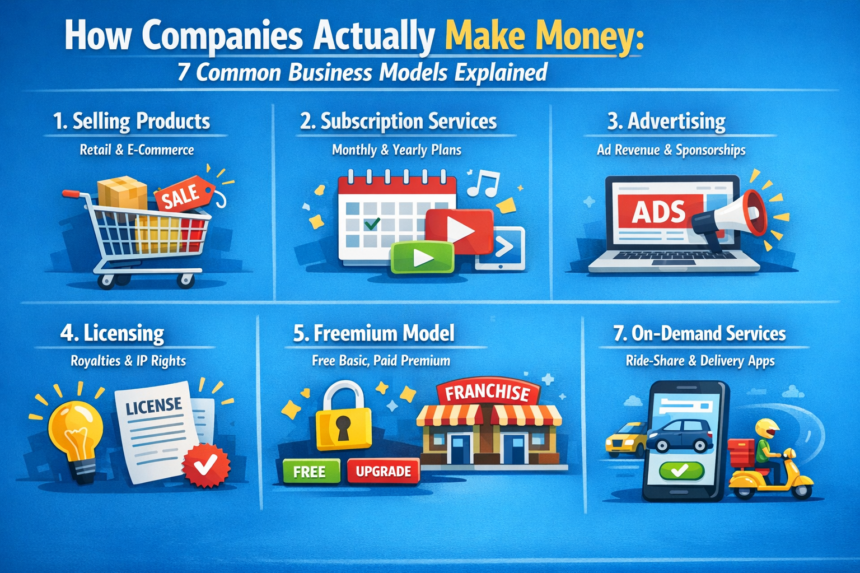
A business model is simply the answer to three questions: who pays, what do they pay for, and how often. Two companies can sell similar things and still make money in very different ways, and that difference shapes their costs, risks, and growth.
Understanding common models helps you read business news, evaluate a startup idea, or make sense of the apps and services you use every day.
1. Selling products
The classic model: make or source a product and sell it for more than it costs. Retailers, manufacturers, and online stores work this way.
- Strengths: simple to understand and to price.
- Watch out for: inventory, shipping, returns, and thin margins.
2. Subscriptions
Customers pay a recurring fee for ongoing access to a product or service, such as streaming, software, or meal kits.
- Strengths: predictable revenue and stronger customer relationships.
- Watch out for: churn, meaning customers cancelling, and the need to keep delivering fresh value.
3. Advertising
The audience often uses the product for free, and advertisers pay to reach them. Search engines, social platforms, and many media sites use this model.
- Strengths: can reach a very large audience.
- Watch out for: dependence on traffic, privacy rules, and advertiser budgets.
4. Marketplaces and commissions
A platform connects buyers and sellers and takes a share of each transaction or charges listing fees.
- Strengths: scales without owning inventory.
- Watch out for: attracting both sides at once, and keeping trust and quality high.
5. Freemium
A free tier draws users in, and a portion of them upgrade to paid features.
- Strengths: low barrier to trying the product.
- Watch out for: converting enough free users to cover costs.
6. Licensing and franchising
A company lets others use its technology, brand, or content in exchange for fees or royalties.
- Strengths: growth with less capital from the owner.
- Watch out for: protecting quality and reputation across partners.
7. Services and consulting
Customers pay for expertise or time, billed by the hour, by project, or on retainer.
- Strengths: low startup cost and quick revenue.
- Watch out for: revenue tied to people’s time, which limits scale.
The models side by side
| Model | Who pays | Revenue rhythm | Main risk |
|---|---|---|---|
| Product sales | Buyers | Per sale | Inventory and margins |
| Subscription | Subscribers | Recurring | Churn |
| Advertising | Advertisers | Ongoing, based on audience | Audience and ad demand |
| Marketplace | Buyers or sellers, per transaction | Per transaction | Two-sided growth |
| Freemium | A share of users | Recurring or one-time | Low conversion |
| Licensing | Licensees | Fees or royalties | Brand control |
| Services | Clients | Per project or hour | Limited by time |
Most companies mix models
A software company may sell subscriptions, offer a free tier, and license technology to partners. A retailer may sell products and run a marketplace. When you read about a company, ask which model drives most of its revenue and which is a side business.
Questions for judging any model
- Who is the real customer, and who actually pays?
- How much does it cost to serve one more customer?
- Is revenue one-time or recurring?
- What stops competitors from copying it?
- How does the company grow: more customers, higher prices, or more products per customer?
Framework tools such as the Business Model Canvas can help you map these answers on one page.
Choosing a model for your own idea
Match the model to how customers already buy in your market. Test willingness to pay early, using the methods in [[validate-startup-idea-before-building|how to validate a startup idea]]. If you run an online shop, our overview of [[best-e-commerce-tools-and-trends-for-small-businesses-in-2026|e-commerce tools for small businesses]] shows the practical side, and a steady [[small-business-bookkeeping-monthly-routine|bookkeeping routine]] tells you whether the model is working.
FAQ
Which model is best?
There is no universal winner. The best model fits your customers, costs, and goals.
Can a business change its model?
Yes, and many do as they grow, but changes carry risk and should be tested.
How can I tell what a company’s model is?
Read its annual report or earnings coverage. Our guide to [[how-to-read-a-business-news-story-earnings-guidance|reading business news]] explains where to look.
The takeaway
If you can say who pays, for what, and how often, you understand the business. Practice on companies you know, and you will start to see patterns everywhere.