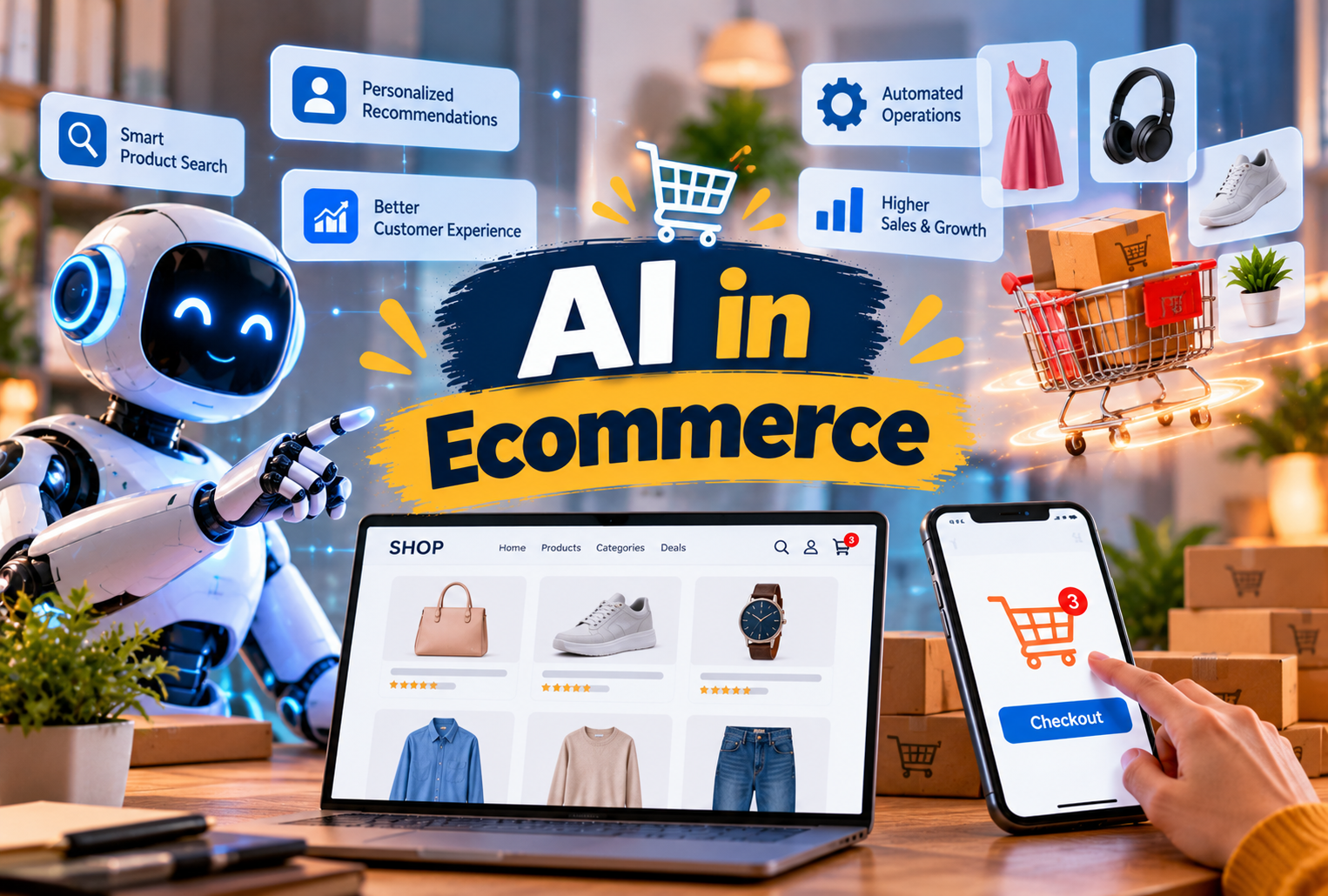
Artificial intelligence is transforming the way people discover products, compare prices, and shop online. From personalized product recommendations to AI-powered shopping assistants, modern ecommerce platforms are using intelligent technology to create faster, more convenient, and more relevant shopping experiences.
In 2026, AI in ecommerce is becoming an important part of online retail strategies. Businesses are using artificial intelligence to understand customer preferences, improve product searches, automate customer service, manage inventory, and make better business decisions.
For shoppers, these developments can make it easier to find suitable products without spending hours browsing different websites. For online businesses, AI tools can help reduce repetitive work, improve customer engagement, and identify opportunities to improve sales.
However, successful AI adoption also requires businesses to consider data privacy, accuracy, transparency, and the cost of implementing new technologies.
This article explores how AI tools are changing online shopping and ecommerce, the benefits they offer, and the trends businesses should understand in 2026.
What Is AI in Ecommerce?
AI in ecommerce refers to the use of artificial intelligence technologies to improve online shopping, retail operations, customer interactions, and business decision-making.
These technologies can analyze information, recognize patterns, understand natural language, and generate responses or recommendations based on available data.
For example, an online clothing store may use AI to recommend products based on a customer's browsing history, previous purchases, and selected preferences. Another store might use an AI assistant to answer questions about product specifications, shipping, and return policies.
Common applications of artificial intelligence in ecommerce include:
-
Personalized product recommendations
-
AI-powered search and product discovery
-
Automated customer support
-
Product descriptions and content generation
-
Demand forecasting and inventory management
-
Fraud detection and transaction monitoring
-
Marketing analysis and customer segmentation
-
AI shopping assistants
To understand the underlying technology, explore Artificial Intelligence on Wikipedia and the IBM guide to AI in retail.
1. Personalized Shopping Experiences
One of the biggest ways AI is changing online shopping is through personalization. Traditional ecommerce websites often display similar product categories to every visitor. AI-powered platforms can use available customer data to make product discovery more relevant to individual interests.
For example, a customer searching for running shoes may receive recommendations for sports socks, fitness accessories, or other footwear based on their shopping activity and preferences.
AI systems can also help businesses personalize product listings, promotional messages, and website content.
How AI Personalization Works
AI tools may analyze several types of information, including:
-
Previous purchases
-
Product searches and browsing activity
-
Selected preferences
-
Products added to wish lists or shopping carts
-
Interactions with previous recommendations
Using this information, recommendation systems estimate which products may be relevant to a shopper.
However, personalization works best when the data is accurate, relevant, and collected responsibly. Businesses should provide appropriate privacy controls and avoid collecting unnecessary personal information.
For more background, see Google Cloud's AI and machine learning resources.
2. AI Shopping Assistants Make Product Discovery Easier
AI shopping assistants are changing how customers interact with ecommerce websites. Instead of navigating multiple categories and filters, shoppers can describe what they need in everyday language.
For example, a customer might ask, "Find comfortable office shoes under ₹3,000 that are suitable for daily walking."
An AI shopping assistant could help narrow the available options based on price, product descriptions, features, and other relevant details.
Depending on the platform, it may also answer questions about product compatibility, compare alternatives, and explain differences between products.
Benefits of AI Shopping Assistants
-
Help customers discover relevant products more quickly.
-
Answer common product-related questions.
-
Simplify comparisons between different options.
-
Support customers outside normal business hours.
-
Reduce the effort required to navigate large product catalogs.
Businesses should ensure that assistants use reliable product information and clearly communicate when they cannot verify a specification, price, or stock status.
AI-generated recommendations should support customer decisions rather than replace accurate product information.
3. Smarter Product Search and Visual Shopping
Traditional ecommerce searches often depend heavily on the words customers enter. However, shoppers do not always know the exact name or technical description of the product they want.
AI-powered search can improve product discovery by interpreting natural-language queries, understanding related terms, and using product attributes to identify relevant results.
For example, someone searching for "a lightweight backpack for a weekend trip" may receive relevant products even when their descriptions do not contain that exact phrase.
Visual search offers another useful application. Customers can upload an image of a product or a similar item to discover matching or related products, where the platform supports this functionality.
Why AI Search Matters for Ecommerce
Better product discovery can help customers find useful items with fewer searches. It can also help online retailers make large product catalogs easier to navigate.
Businesses can improve AI search performance by maintaining accurate product titles, detailed descriptions, consistent category structures, high-quality images, and reliable product attributes.
AI cannot compensate for every catalog problem. Incorrect descriptions, missing specifications, and outdated inventory data can still produce poor search results.
4. AI Is Transforming Ecommerce Customer Service
Customer service is another area where artificial intelligence is making a difference. AI-powered chatbots and virtual assistants can respond to common questions about shipping, order status, returns, product availability, and store policies.
Instead of waiting for a human representative, customers may receive immediate assistance with routine requests.
For example, an AI customer service tool integrated with an order management system could retrieve an order's current status and explain the next steps to a customer.
More advanced systems may help route complicated queries to the appropriate support team.
AI Chatbots vs. Human Customer Support
AI tools can handle repetitive questions efficiently, but human support remains important for sensitive, unusual, or complicated situations.
A practical ecommerce customer service strategy combines automation with human assistance. The AI system should recognize when it lacks sufficient information or when a customer needs to speak with a person.
Businesses should also regularly test automated responses to ensure they reflect current return policies, delivery conditions, and product information.
Learn more about Google Cloud's conversational AI solutions.
5. Automated Product Descriptions and Ecommerce Content
Managing product content can be time-consuming for online stores with hundreds or thousands of listings. AI content tools can help generate initial product descriptions, summarize specifications, suggest titles, and organize product information.
For instance, a retailer selling home appliances could use AI to create a first draft based on verified details such as capacity, dimensions, power consumption, and warranty information.
Marketing teams can also use AI to brainstorm email campaigns, advertising variations, category introductions, and social media content.
How Businesses Can Use AI Content Tools
-
Create first drafts of product descriptions.
-
Rewrite technical specifications in simpler language.
-
Generate alternative product titles for testing.
-
Prepare content variations for different customer segments.
-
Identify missing information in product listings.
AI-generated content should always be checked for accuracy, originality, brand consistency, and compliance with applicable policies.
Businesses should never allow an AI tool to invent product specifications, guarantees, customer reviews, or performance claims.
For guidance on responsible AI-generated content in search, see Google Search Central's guidance on AI-generated content.
6. AI Improves Inventory Management and Demand Forecasting
Inventory management can be challenging for ecommerce businesses because customer demand changes with seasons, promotions, market conditions, and product trends.
AI forecasting tools can analyze historical sales, product performance, seasonal patterns, and other available information to estimate future demand.
For example, an online retailer may use forecasting software to anticipate increased demand for certain products during a festive sale. This information can help the business plan purchasing, storage, and replenishment.
AI can also help identify products that may be selling more slowly than expected or highlight unusual changes in demand.
Business Benefits
-
Better-informed inventory planning
-
Earlier identification of potential stock shortages
-
Reduced risk of excess inventory
-
Improved coordination between sales and purchasing teams
-
More efficient use of warehouse resources
Forecasts are not guarantees. Their quality depends on data accuracy, changing market conditions, and the assumptions built into the system. Businesses should combine AI predictions with operational knowledge and regular reviews.
7. AI-Powered Fraud Detection and Payment Security
Online retailers must protect customers and businesses against suspicious transactions, account misuse, and payment fraud.
AI-powered fraud detection systems can analyze transaction patterns, device information, account behavior, and other authorized signals to identify activity that may require further investigation.
For example, a payment system may flag an unusual transaction for additional verification instead of automatically treating every purchase as legitimate.
AI can also help security teams prioritize alerts and investigate patterns across multiple transactions.
However, automated decisions can produce false positives, meaning legitimate customers may sometimes be flagged incorrectly. Ecommerce businesses should provide appropriate review procedures and avoid relying on a single automated signal for every decision.
Organizations must also protect payment information and follow applicable security requirements.
For payment security guidance, visit the PCI Security Standards Council.
8. AI Helps Ecommerce Businesses Improve Marketing
Marketing teams can use artificial intelligence to analyze campaign performance, organize customer segments, generate creative variations, and identify patterns in customer behavior.
For example, an online store may analyze which product categories attract more interest from different audience segments and use those insights to refine its marketing strategy.
AI tools can also assist with email subject lines, advertising copy, campaign planning, and customer retention analysis.
Practical Applications of AI Marketing Tools
-
Drafting marketing emails and promotional content
-
Grouping customers based on relevant behavior
-
Analyzing advertising campaign performance
-
Identifying products suitable for cross-selling
-
Supporting customer retention campaigns
-
Generating creative variations for testing
AI can speed up marketing workflows, but businesses still need human judgment to maintain brand voice, verify claims, and ensure that targeting practices respect customer privacy.
For more information, explore Google Analytics, which helps businesses understand website traffic and user interactions.
9. AI and the Future of Ecommerce Automation
Ecommerce automation is moving beyond individual tasks toward connected workflows. Depending on their capabilities and permissions, AI agents may help coordinate activities such as summarizing customer inquiries, retrieving order information, drafting responses, and updating internal systems.
For example, a retailer might use an AI-assisted workflow to identify a delayed shipment, prepare a customer notification, and send it for approval before delivery to the customer.
These workflows can reduce repetitive work, but they also require safeguards. An incorrectly configured system could send inaccurate messages, update records improperly, or expose confidential information.
Businesses should introduce automation gradually, starting with low-risk and reversible tasks. High-impact actions, such as issuing large refunds or changing payment details, should have stronger authorization and human oversight.
10. Benefits of AI in Ecommerce for Small Businesses
AI technology is not limited to large ecommerce companies. Small businesses can also use accessible tools to improve day-to-day operations.
For example, a small online clothing store may use AI to draft product descriptions, answer common questions, analyze sales reports, and create promotional content.
A home decor business could use AI-assisted search and product recommendations to help shoppers navigate its catalog.
Key Advantages
Time savings: AI can reduce repetitive content and administrative work.
Improved customer experience: Relevant search results and timely support can make shopping easier.
Better business insights: Analytics tools can help identify sales patterns and customer interests.
Scalable operations: Automation may help businesses manage higher volumes without increasing every manual task.
More efficient marketing: AI can assist with campaign ideas and content variations.
Small businesses should start with a specific problem and compare the cost, reliability, privacy requirements, and expected benefits of available tools before investing in a larger system.
Challenges and Risks of Using AI in Ecommerce
Although artificial intelligence offers many advantages, businesses should understand its limitations before implementing it.
Data Privacy
Personalized shopping and automated customer service may rely on customer information. Businesses should collect only necessary data, protect it appropriately, and follow applicable privacy laws.
Inaccurate Information
AI tools can generate incorrect product descriptions, inaccurate recommendations, or misleading customer support answers. Important information should be checked against reliable business records.
Implementation Costs
Some AI tools require subscription fees, technical integrations, staff training, and ongoing maintenance. Businesses should evaluate the total cost rather than considering only the initial price.
Bias and Unfair Recommendations
AI systems may produce uneven results if their training data or business rules favor certain products or customer groups. Regular testing can help identify and address these problems.
Customer Trust
Customers should be able to understand when they are interacting with an automated assistant and how to reach a human representative when needed.
Responsible implementation is essential for building long-term trust and ensuring that AI supports the business rather than creating additional operational problems.
Top AI Tools Ecommerce Businesses Can Explore in 2026
Different tools serve different purposes, so businesses should choose based on their platform, budget, and specific requirements.
| Tool | Potential ecommerce use |
|---|---|
| Shopify Magic | AI-assisted store content and merchant workflows |
| Google Cloud AI | Machine learning, search, and AI application development |
| Adobe Firefly | Generating and editing marketing visuals |
| ChatGPT | Drafting product content, brainstorming campaigns, and analyzing information |
| Google Analytics | Understanding website traffic and customer interactions |
Features, availability, integrations, and pricing may vary by product and plan. Businesses should verify current details with the provider before selecting a tool.
Ecommerce Trends to Watch in 2026
The role of AI in online shopping continues to evolve. Several developments are worth monitoring as ecommerce businesses plan their technology investments.
More Conversational Shopping
Customers may increasingly use natural-language interfaces to describe their needs, compare products, and ask follow-up questions.
More Contextual Recommendations
Recommendation systems may combine product attributes, customer preferences, and shopping context to produce more relevant results, subject to available data and privacy settings.
Greater Use of Visual Discovery
Image-based product search and AI-assisted visual content may help shoppers discover products more naturally.
Connected Automation Workflows
Businesses may connect customer service, inventory, marketing, and order management tools to reduce repetitive manual work.
Increased Focus on Trust and Transparency
As AI becomes more involved in purchasing decisions, accurate product information, data protection, clear disclosures, and human oversight will remain important.
These are developing trends rather than guaranteed outcomes. Their adoption will depend on customer preferences, business needs, technology costs, and regulatory requirements.
Conclusion
AI is changing online shopping and ecommerce by making product discovery more personalized, customer service more responsive, and business operations more automated.
From AI shopping assistants and smarter search to inventory forecasting, fraud detection, and marketing support, these technologies offer practical opportunities for businesses of different sizes.
However, successful adoption requires more than adding AI features to an online store. Businesses must ensure that product information is accurate, customer data is protected, automated decisions are reviewed appropriately, and customers can access human support when necessary.
In 2026, the most effective approach is to use AI where it solves a genuine business problem, measure its results, and improve the system over time.
For ecommerce businesses, artificial intelligence is best viewed as a tool that can strengthen human decision-making and improve customer experiences—not as a replacement for sound business practices, reliable data, or customer trust.