


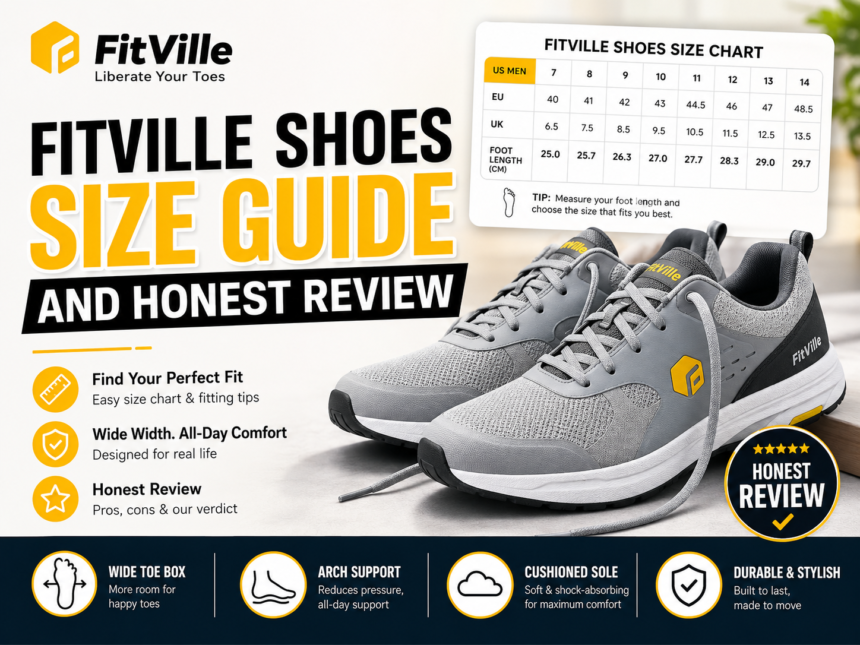
Quick answer: FitVille shoes run true to length but offer extra room in the width. To get the right fit, measure your foot length in millimeters and pick your width from four options: Medium, 2E/Wide, 4E/Extra Wide, or 6E/XX-Wide. Most buyers with wide feet or foot pain find FitVille comfortable, well-built, and worth the price.
Buying shoes online sounds easy until the box arrives and nothing fits right. The length feels close, but the toe box pinches. Or the width is fine, but your heel slips with every step. This is the exact problem FitVille tries to solve, and it is why so many shoppers search for a clear fitville shoes size guide before they buy.
This post gives you that guide. You will learn how FitVille sizing works, how to measure your feet at home, and what to expect from comfort and quality. We also include an honest fitville shoes review based on real wearer feedback and a physical therapist’s assessment, so you know what holds up in daily use and what does not.
If you have wide feet, sore joints, or a foot condition that makes regular sneakers hurt, read this before you spend a cent.
What does the FitVille shoes size guide tell you?
FitVille builds shoes around two numbers: length and width girth. Most brands give you length only and assume everyone has the same width. That assumption fails for anyone with a wide foot.
Here is the men’s sizing layout from the official fitville shoes size guide:
- US sizes run from 7 to 16, with UK and EU conversions listed for each.
- Foot length is measured in millimeters, from 247 mm (US 7) up to 328 mm (US 16).
- Four width options cover most feet: Medium, 2E/Wide, 4E/Extra Wide, and 6E/XX-Wide.
The width labels matter more than the names suggest:
- 2E/Wide fits normal to wide feet.
- 4E/Extra Wide fits extra-wide feet.
- 6E/XX-Wide fits the widest feet, including swollen feet or feet that need a thick orthotic.
A US 9 in Medium has a 251.98 mm girth. The same US 9 in 6E/XX-Wide jumps to 271.03 mm. That is nearly 20 mm of extra room across the ball of the foot. For someone with bunions or swelling, that gap is the difference between pain and comfort.
You can find the full fitville shoes size guide on the brand’s site, including a separate width guide that explains 2E, 4E, and 6E in detail.
How do you get FitVille shoes sizing right?
Guessing your size online usually ends in a return. A few simple steps fix that. Good fitville shoes sizing starts with a measurement, not a hunch.
- Trace your foot. Stand on a sheet of paper and trace around your foot with a pen held straight up. Do this in the evening, when feet are at their largest.
- Measure the length. Mark the longest point and the back of your heel. Measure the distance in millimeters.
- Match the length to the chart. Find your millimeter length in the size guide and read across to your US, UK, or EU size.
- Measure your width girth. Wrap a soft tape around the widest part of your foot. Match that number to the 2E, 4E, or 6E columns.
- Round up if you are between sizes. A little extra length beats a tight toe box, especially for walking or running.
A quick tip on fitville shoes sizing: if you wear thick socks, use a custom orthotic, or have swelling later in the day, size up in width before you size up in length. The width is what most regular shoes get wrong.
Honest review: are FitVille shoes comfortable and well made?
Comfort claims sound the same across every shoe brand until you wear the shoe for eight hours. So here is the honest version.
A physical therapist who tested three FitVille models, the Rebound Core, Stride Core, and Refresh Core, rated them highly on build quality. Her review noted excellent construction, solid materials, and sturdy, medium-to-rigid support. These are not soft, flimsy sneakers. They hold your foot in place.
The same review flagged who these shoes suit and who they do not:
- Best for wide and extra-wide feet, plus painful foot conditions like bunions, hammer toes, flat feet, plantar fasciitis, heel pain, neuropathy, diabetes, and arthritis.
- Also helpful for knee, hip, and low back pain, since better foot support changes how you stand and walk.
- Great for orthotics, especially thick ones with high arch support that make other shoes feel tight.
- Not ideal for narrow or medium-width feet, since the wide build will feel loose.
On weight, each shoe runs about 11 to 12 ounces (320 to 340 grams). That sits in the middle range for walking shoes and on the heavier end for running shoes. You feel the support, not lightness.
One more honest point from this fitville shoes review: the styling looks modern, not clinical. Older orthopedic shoes tend to look like medical devices. FitVille shoes pass as regular athletic shoes, which is why wearers use them for travel, errands, and casual events, not just therapy.
What are the best FitVille shoes for walking?
Walking shoes get judged on one thing: how your feet feel after a few miles. The best fitville shoes for walking combine wide room, cushioning, and support that does not collapse over distance.
Based on the lineup and review feedback, three models stand out for walking:
- Rebound Core. A popular all-day model with cushioning built for long walks and standing shifts.
- Stride Core. A balanced walking and running option with steady support.
- Refresh Core. A comfort-focused pick for everyday walking and casual wear.
When you compare the best fitville shoes for walking, choose by use case:
- Choose Rebound Core if you stand all day or walk long distances and want maximum cushioning.
- Choose Stride Core if you mix walking with light running.
- Choose Refresh Core if you want comfort for daily errands and casual outings.
All three come in wide and extra-wide widths, so the walking comfort depends as much on picking the right width as on picking the right model.
FitVille wide shoes review: do they deliver on the wide promise?
Plenty of brands slap the word “wide” on a shoe that is barely wider than standard. That is the gap a real fitville wide shoes review needs to close.
FitVille’s wide build is genuine. The girth numbers in the size chart prove it, and the physical therapist review confirmed the shoes “look wider than a medium width shoe” because they actually are. For someone with a true wide foot, that is the point.
Here is what stands out in this fitville wide shoes review:
- Real width range. Three wide tiers (2E, 4E, 6E) instead of one vague “wide” label.
- Room for swelling and orthotics. The 6E option fits feet that no standard shoe accommodates.
- Support that matches the width. Wide does not mean sloppy here. The shoes still hold the foot.
The same wide build is also the main warning. If your feet are narrow or medium, these shoes will feel roomy and loose. The wide promise is real, which is exactly why narrow-footed buyers should look elsewhere.
Pros and cons of FitVille shoes
Every shoe has trade-offs. A fair fitville shoes review names both sides.
Pros
- True wide and extra-wide fit with four width options up to 6E/XX-Wide.
- Strong support and build quality, rated highly by a physical therapist.
- Good for foot conditions like plantar fasciitis, bunions, diabetes, and arthritis.
- Fits thick orthotics that crowd other shoes.
- Modern styling that works beyond medical use.
- FDA-registered as a device, with free shipping over $80 and a first-order discount.
Cons
- Not for narrow or medium feet. The wide build feels loose on slim feet.
- Heavier than most running shoes, at 11 to 12 ounces per shoe.
- Runs wide overall, so length-only shoppers may misjudge the fit.
- Online sizing takes effort. You need to measure to get it right.
Final verdict: should you buy FitVille shoes?
FitVille solves one problem well: comfortable, supportive shoes for wide feet and sore feet. If that describes you, the answer is straightforward.
Buy FitVille if you have wide or extra-wide feet, a painful foot condition, or you wear thick orthotics. The width range, support, and build quality match the price, and the modern look means you can wear them anywhere.
Skip FitVille if you have narrow or medium feet or want the lightest possible running shoe. The wide fit that helps so many wearers will work against you.
Before you order, do two things. Measure your foot length and width girth, then match both to the official fitville shoes size guide. That single step prevents most returns and gives you the comfort these shoes are built for.
Frequently asked questions
Do FitVille shoes run true to size?
FitVille shoes run true to length but wide in width. Use your measured millimeter length for the size, then choose your width from Medium, 2E, 4E, or 6E. Most length-based mistakes come from ignoring the width chart.
Are FitVille shoes good for wide feet?
Yes. FitVille is built for wide feet, with four width tiers up to 6E/XX-Wide. The girth measurements in the size chart confirm the extra room, which makes them a strong choice for bunions, swelling, and orthotics.
What are the best FitVille shoes for walking?
The Rebound Core, Stride Core, and Refresh Core are the top picks. Choose Rebound Core for long walks and all-day standing, Stride Core for mixed walking and running, and Refresh Core for everyday casual walking.
Are FitVille shoes good for plantar fasciitis or foot pain?
A physical therapist review rated them helpful for plantar fasciitis, bunions, flat feet, heel pain, neuropathy, diabetes, and arthritis. The sturdy support also helps some people with knee, hip, and low back pain.
Can I use my own orthotics in FitVille shoes?
Yes. FitVille shoes fit thick custom orthotics with high arch support that often make other shoes feel tight. This is one of the main reasons orthotic wearers choose them.
How heavy are FitVille shoes?
Each shoe weighs about 11 to 12 ounces (320 to 340 grams). That is mid-range for walking shoes and on the heavier side for running shoes, since the weight comes from added support.
Also Read: FitVille Shoes – Experience Unmatched Comfort, Support & Perfect Fit