
The hardest part of planning a trip is often the start. There are endless destinations, thousands of hotels, and a flood of advice. A simple sequence helps you decide things in the right order, so you are not booking flights before you know the budget or choosing hotels before you know the dates.
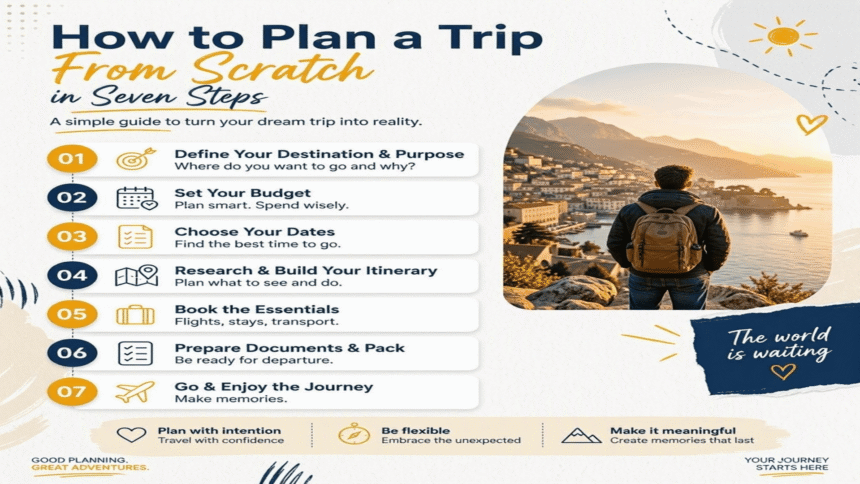
Here is a seven-step framework that works for a weekend away or a multi-week adventure.
Step 1: Define the purpose and the limits
Start by answering four questions: Why are you going, who is coming, how many days do you have, and what is the total you can spend? A relaxing beach break and a city culture trip lead to very different choices. Note any non-negotiables, such as accessibility needs, school dates, or work deadlines.
Step 2: Choose a destination that fits
Match the destination to your purpose, season, and budget. Check weather and crowd patterns for your dates, typical costs, travel time, and whether you need a visa or travel authorization. If you are heading to Europe from outside the EU, our explainer on the [[schengen-90-180-rule-ees-etias-explained|Schengen 90/180 rule, EES, and ETIAS]] covers the entry basics.
Step 3: Set a realistic budget
Divide your total into categories, then add a buffer of about 10 to 15 percent for surprises.
| Category | What it includes | Tip |
|---|---|---|
| Transport | Flights or trains, local transit, airport transfers | Compare total cost, not just the ticket price |
| Lodging | Hotels, rentals, hostels | Check cancellation terms and location |
| Food | Meals and snacks | Mix restaurant meals with cheaper options |
| Activities | Tours, tickets, entry fees | Prioritize two or three big items |
| Insurance and documents | Travel insurance, visas, vaccinations if needed | Compare coverage, not just price |
| Buffer | Unplanned costs | Keep it separate |
Step 4: Book the big pieces first
Once dates and budget are firm, book the main transport and lodging. Choose flexible or refundable options when plans might change. Check that your passport is valid for the length of stay and any rules that require extra validity. Save confirmations in one place, online and offline.
Step 5: Build a light itinerary
List must-see places, then group them by area to avoid zigzagging across town. Plan one or two anchors per day, such as a museum in the morning and a neighborhood walk in the afternoon, and leave open time. Note opening days and any tickets that must be reserved in advance. Overpacked itineraries are the most common regret.
Step 6: Prepare the essentials
- Money: learn how to avoid poor exchange rates and fees with our guide to [[how-to-pay-abroad-cards-cash-fees|paying abroad]].
- Phone and data: check roaming charges or plan an eSIM or local SIM.
- Health: review vaccination advice, prescriptions, and insurance coverage.
- Copies: keep digital and paper copies of your passport, tickets, and insurance details.
- Security: back up your photos, and protect key accounts with a [[password-manager-and-passkeys-beginner-setup|password manager and two-step sign-in]].
Step 7: Pack and go
Make a packing list a week ahead, favor carry-on where possible, and check airline baggage rules. Leave your itinerary with someone at home. Arrive with a loose plan and permission to change it.
A simple planning timeline
- Three to six months out: choose destination and dates, set the budget.
- Two to three months out: book transport and lodging, check documents.
- One month out: reserve key activities, arrange insurance and money.
- One week out: confirm bookings, pack, and download maps and tickets.
For a city-by-city example, see our [[poland-first-timers-guide-where-to-go-how-to-get-around|Poland first-timer’s guide]].
FAQ
How far ahead should I book flights?
There is no single best time, and it varies by route and season. Compare prices over a few weeks, and book earlier for holidays and busy periods.
Do I need travel insurance?
It is worth considering, especially for expensive or international trips. Read what is and is not covered.
How many things should I plan per day?
Two main activities and some free time is a comfortable pace for most people.
The takeaway
Decide the purpose and limits, choose the destination, set the budget, book the big pieces, build a light itinerary, prepare, and go. A short, ordered plan removes most of the stress.