
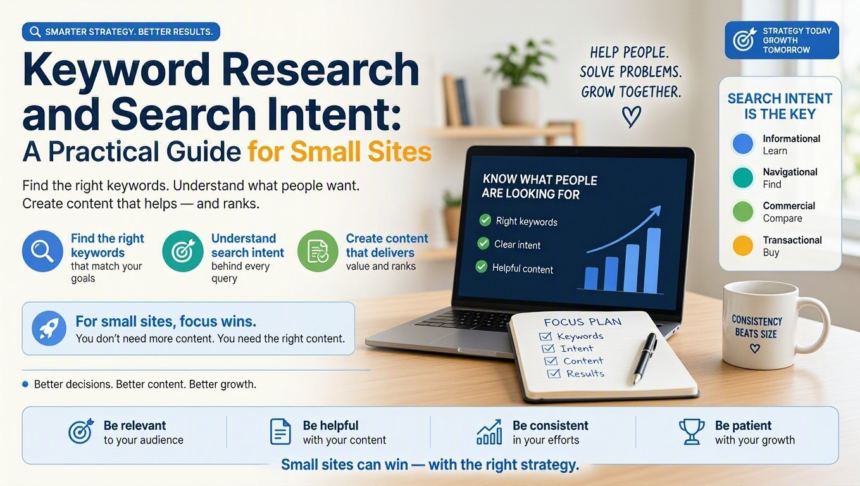
Many small sites write articles about what they want to say rather than what people are looking for, then wonder why no one finds them. Keyword research fixes that by starting with your audience’s own words. Search intent, the reason behind a query, tells you what kind of page they hope to land on.
This guide uses free or low-cost methods, so it works for a small business, blog, or online store.
Start with search intent
Every search has a goal. Matching your page to that goal matters more than repeating a phrase.
| Intent | What the person wants | Example query | Best page type |
|---|---|---|---|
| Informational | To learn | how to clean a cast iron pan | Guide or how-to article |
| Navigational | To reach a specific site | your brand login | Clear brand and login pages |
| Commercial investigation | To compare before buying | best budget blenders | Comparison or review page |
| Transactional | To buy or sign up | buy stainless steel water bottle | Product or service page |
To check intent, search the phrase and look at what already ranks. If the top results are all how-to guides and you have a product page, you are probably mismatched.
Step 1: Build a seed list
Write the topics your business or site covers, in the words your customers use. Ask: What questions do customers email us? What do they mention on sales calls? What would a beginner ask?
Step 2: Expand it with free sources
- Search suggestions: type a seed into a search box and note the autocomplete options.
- Related searches and ‘People also ask’ boxes: these show follow-up questions.
- Forums and communities: see how people describe their problems.
- Your own site search and support emails: real questions from real visitors.
- Free tools: keyword planning and trends tools from search engines and analytics platforms give ideas, and the Search Console report shows what your site already appears for.
Step 3: Judge each keyword
For every promising phrase, ask:
- Relevance: does it match what we offer?
- Intent: can we satisfy it with our page?
- Competition: are the top results dominated by large brands, or do smaller sites appear?
- Specificity: long-tail phrases with more words are often easier to win and closer to purchase intent.
A focused phrase like ‘gluten-free birthday cakes in your city’ can bring better visitors than a broad term such as ‘cakes.’
Step 4: Map keywords to pages
Give each page one main topic and a primary phrase, plus a few supporting phrases. Avoid creating several thin pages for near-identical queries. A simple spreadsheet with columns for page, primary keyword, intent, and status keeps things organized.
Step 5: Write for people first
Use the phrase naturally in the title, main heading, first paragraph, and a few subheadings. Then focus on answering the question better than existing pages: clear steps, original examples, and honest detail. Never stuff keywords, since it reads badly and does not help.
Link related pages to each other so visitors, and search engines, can follow the trail. If you sell online, our [[best-e-commerce-tools-and-trends-for-small-businesses-in-2026|guide to e-commerce tools]] is a related read.
Step 6: Measure and improve
After a few weeks, check Search Console for impressions, clicks, and average position. Look for queries where you appear on the second page and improve those pages with better answers. Update older content regularly.
Use AI carefully
AI assistants can brainstorm topics and questions, and our [[how-to-write-better-ai-prompts|prompt framework]] can help, but verify anything factual and do not publish generic text. Search data and your own expertise should lead.
Common mistakes
- Chasing only high-volume terms.
- Ignoring intent.
- Targeting the same keyword on many pages.
- Expecting results overnight. SEO usually takes months.
FAQ
How many keywords per page?
One primary topic, with a handful of related phrases that fit naturally.
Do I need paid tools?
Not to start. Free sources and your own data go a long way.
How do I know if a keyword is worth it?
Combine relevance, intent, realistic competition, and how close the searcher is to becoming a customer.
The takeaway
Start with intent, collect real phrases, choose realistic targets, and map them to helpful pages. If you are still validating your offer, read [[validate-startup-idea-before-building|how to validate a startup idea]] before investing in content.